
图书介绍
大学英语四级考试语法结构强化训练 新题型pdf电子书版本下载
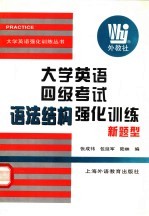
- 张成祎等编著 著
- 出版社: 上海:上海外语教育出版社
- ISBN:7810465937
- 出版时间:1999
- 标注页数:276页
- 文件大小:10MB
- 文件页数:286页
- 主题词:
PDF下载
下载说明
大学英语四级考试语法结构强化训练 新题型PDF格式电子书版下载
下载的文件为RAR压缩包。需要使用解压软件进行解压得到PDF格式图书。建议使用BT下载工具Free Download Manager进行下载,简称FDM(免费,没有广告,支持多平台)。本站资源全部打包为BT种子。所以需要使用专业的BT下载软件进行下载。如 BitComet qBittorrent uTorrent等BT下载工具。迅雷目前由于本站不是热门资源。不推荐使用!后期资源热门了。安装了迅雷也可以迅雷进行下载!
(文件页数 要大于 标注页数,上中下等多册电子书除外)
注意:本站所有压缩包均有解压码: 点击下载压缩包解压工具
图书目录
Chapter 1 Verb Tenses 1
1-1 Simple present 1
1-2 Present progressive 1
1-3 Verbs usually not used in any of the progressive tenses 2
1-4 Simple past and past progressive 4
1-5 Present perfect 5
1-6 Present perfect progressive 7
1-7 Past perfect and past perfect progressive 9
1-8 Simple future/going to 10
1-9 Using present progressive and simple present to express future time 11
1-10 Using be about to and be to to express future time 12
1-11 Future perfect 13
1-12 Tense sequence 14
Chapter 2 The Passive 17
2-1 Passive verbs and the by phrase 17
2-2 Using passive verbs in other cases 18
2-3 Passive verbs used as adjectives 19
2-4 Passive verbs with get 20
2-5 Using be used to and used to 21
3-1 Untrue conditional sentences referring to present or future 24
Chapter 3 The Subjunctive 24
3-2 Untrue conditional sentences referring to past 25
3-3 Using mixed time in conditional sentences 26
3-4 Using could,might,should 27
3-5 Omitting if 27
3-6 Implied conditions 28
3-7 Subjunctive in the simple form of a verb 29
3-8 Verb forms following wish 31
3-9 Verb forms following if only 32
3-11 Using as if/as though 33
3-10 Verb forms following would rather/would sooner 33
3-12 Using it s time 34
Chapter 4 Model Auxiliaries 37
4-1 Asking polite questions 37
4-2 Using would you mind 37
4-3 Expressing advisability:should,ought to,had better 38
4-4 Should and ought to with verbs in perfect forms 39
4-5 Expressing necessity:must,have to,have got to 40
4-6 Using must,have to and need in negative forms 41
4-7 Expressing possibility:may,might 42
4-8 Expressing probability:must 43
4-9 Expressing expectation:should,ought to 45
4-10 Expressing preference:would rather,would sooner,would like 46
Chapter 5 Subject-Verb Agreement 49
5-1 Basics 49
5-2 Using or,either...or,neither...nor,not only...but also,not...but 50
5-3 Using singular words 51
5-4 Using expressions of quantity 52
5-5 Using there be 53
5-6 Using people,police,cattle 54
5-7 Using the+adjective 54
5-8 Some irregularities 55
5-9 Using collective nouns 56
Chapter 6 Questions 60
6-1 Yes/No questions 60
6-2 Information questions 61
6-3 Using which,what,who 61
6-4 Using how,what...like 62
6-6 Using how about,what about 64
6-5 Using how and what in exclamations 64
6-7 Using why(not)+bare infinitive 65
6-8 Negative questions 66
6-9 Tag questions 67
Chapter 7 Gerunds and Infinitives 69
7-1 Common verbs followed by gerunds 69
7-2 Common verbs followed by infinitives 69
7-3 Common verbs followed by either gerunds or infinitives 70
7-4 Gerunds or infinitives? 71
7-5 Using gerunds with a possessive 72
7-6 Using gerunds following need,require and want 74
7-7 Special expressions followed by the -ing form of a verb 75
7-8 Using infinitives with question words 77
7-9 Using verb+object+infinitive 79
7-10 Using verb+object+adjective/noun 80
7-11 Using verbs of perception 81
7-12 Using causative verbs:let,make,have;using help 82
7-13 Using infinitives following an adjective 84
7-14 Using infinitives with too and enough 85
7-15 Using infinitives following a noun 86
7-16 Using infinitives to express purpose 87
7-17 Using perfect forms of infinitives 89
7-18 Using to to represent the whole infinitive 90
Chapter 8 Participles 92
8-1 -ing forms and -ed forms 92
8-2 Simple participles used to modify nouns 93
8-3 Participle phrases used as modifiers 93
8-4 Participle phrases used as adverbs 95
8-5 Using perfect participles 97
8-6 Using participle phrases following a conjunction 97
8-7 Special expressions used to modify the whole sentence 98
8-8 Participle phrases with their own subjects 99
8-9 Using with+noun+participles 100
8-10 Participle phrases following an object 101
Chapter 9 Pronouns 103
9-1 Pronoun agreement 103
9-2 Using possessive pronouns 104
9-3 Using reflexive pronouns 105
9-4 Using it as a preparatory subject 106
9-5 Using it as a preparatory object 108
9-6 Using some and any 110
9-7 Other uses of some and any 111
9-8 Using few,a few;little,a little 112
9-9 Using one and ones;that and those 113
9-10 Using other and another 114
Chapter 10 Comparisons 118
10-1 The difference between comparatives and superlatives 118
10-2 Sentences with comparatives 118
10-3 Sentences with superlatives 119
10-4 Using less and least 121
10-5 Using double comparatives;using the more...the more 122
10-6 Making comparisons with as...as 123
10-7 Using like and as 125
10-8 Using the same,similar and different;like,alike 126
Chapter 11 Adjective Clauses 128
11-1 Using relative pronouns:who,whom,which,that 128
11-2 Using whose and of which 130
11-3 Using where,when and why 131
11-4 Using non-identifying adjective clauses 132
11-5 Adjective clauses modifying the whole sentence 133
11-6 Using expressions of quantity in adjective clauses 134
11-7 Using such...as,the same...as 135
Chapter 12 Noun Clauses 138
12-1 Noun clauses beginning with that 138
12-2 Noun clauses beginning with a question word 139
12-3 Using what as a relative pronoun 140
12-4 Noun clauses beginning with whether/if 142
12-5 Noun clauses following an adjective 143
12-6 Noun clauses used as appositives 144
13-1 Parallel structures with and,but,or,nor 146
Chapter 13 Conjunctions 146
13-2 Parallel structures with paired conjunctions 147
13-3 Combining independent clauses with conjunctions 148
13-4 Using conjunctive adverbs 150
13-5 Repeating the same idea:so do...,neither/nor do 152
13-6 Showing contrast:while,whereas 153
13-7 Using on the contrary 153
13-8 Beginning a sentence with a negative word 154
Chapter 14 Adverb Clauses 157
14-1 Showing time relationship:when,while,as 157
14-2 Using after,before;since 158
14-3 Using as soon as,once 159
14-4 Using until,till;by the time(that) 160
14-5 Using hardly/scarcely...when,no sooner...than 161
14-6 Showing cause and effect:because,as,since,now(that) 162
14-7 Using as/so long as,inasmuch as 163
14-8 Using seeing(that),considering(that);in that 164
14-9 Using so...that,such...that;so that 165
14-10 Showing purpose:in order that,so that 167
14-11 Using forfear(that),lest 168
14-12 Showing condition:if,unless 169
14-13 Using provided/providing(that),as/so long as,on condition that 170
14-14 Using supposing/suppose(that),assuming(that) 171
14-15 Using in case 172
14-16 Showing unexpected result:though,although,even though/if 173
14-17 Using-ever words and no matter how,etc 174
14-18 Using whether...or 175
14-19 Using as-clause in inverted order 176
Part 179
Key 219