
图书介绍
指称的概念参照视点 认知语篇学的探索 a cognitive textlinguistic approachpdf电子书版本下载
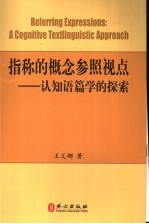
- 王义娜著 著
- 出版社: 北京:外文出版社
- ISBN:7119020358
- 出版时间:2006
- 标注页数:305页
- 文件大小:12MB
- 文件页数:322页
- 主题词:认知科学:语言学-研究
PDF下载
下载说明
指称的概念参照视点 认知语篇学的探索 a cognitive textlinguistic approachPDF格式电子书版下载
下载的文件为RAR压缩包。需要使用解压软件进行解压得到PDF格式图书。建议使用BT下载工具Free Download Manager进行下载,简称FDM(免费,没有广告,支持多平台)。本站资源全部打包为BT种子。所以需要使用专业的BT下载软件进行下载。如 BitComet qBittorrent uTorrent等BT下载工具。迅雷目前由于本站不是热门资源。不推荐使用!后期资源热门了。安装了迅雷也可以迅雷进行下载!
(文件页数 要大于 标注页数,上中下等多册电子书除外)
注意:本站所有压缩包均有解压码: 点击下载压缩包解压工具
图书目录
Chapter 1 Introduction 1
1.1 Reference 1
1.2 Discourse reference 3
1.3 Objectives of this study 7
1.4 Basic assumptions and research methodology 11
1.5 Organization of the book 13
Chapter 2 Previous Researches on Discourse Reference 14
2.1 Textual approaches to discourse reference 15
2.1.1 Halliday Hasan:Textual paradigm 15
2.1.2 Givón:Topic continuity model 18
2.1.3 Fox:the Hierarchy model 21
2.2 Pragmatic approaches to discourse reference 24
2.2.1 Levinson:Neo-Gricean pragmatic model 25
2.2.2 Matsui:Relevance-theoretical model 29
2.3 Cognitive approaches to discourse reference 32
2.3.1 Ariel:Accessibility theory 32
2.3.2 Gundel et al.:the Givenness hierarchy 36
2.3.3 Two given-new taxonomies 40
2.4.1 Li Cherry Ing:a text-oriented analysis 44
2.4 Chinese researches on discourse reference 44
2.4.2 Chen Ping:a discourse-pragmatic analysis 45
2.4.3 Huang Yan:a neo-Gricean pragmatic model 46
2.4.4 Xu Yulong:a functional-pragmatic model 49
2.5 Summary 51
Chapter 3 A Conceptual Framework to Discourse Reference 55
3.1 Theoretical arguments revisited 55
3.1.1 A study of Givenness 56
3.1.2 Accessibility:contributions and limitations 58
3.2 The role of subjectivity in discourse 62
3.3 A conceptual framework to discourse reference 65
3.3.1 Conceptual basis of the model 66
3.3.2 Conceptual reference-point model of discourse reference 75
3.3.3 Interim summary 89
3.4 Summary 93
Chapter 4 The Choice of Lexical Reference in Discourse 96
4.1 Lexical devices in discourse 97
4.2 Discourse conditions for lexical reference 98
4.2.1 Low-accessible conditions 99
4.2.2 Discourse boundary positions 101
4.2.3 Referent-accessible conditions 104
4.3 A CRM analysis of lexical reference 107
4.3.1 Reference point and conceptual prominence 108
4.3.2 Dominion closure and conceptual connectivity 116
4.3.3 Viewpoint effect on conceptual connectivity 124
4.4 Summary:low-subjective construal of the referent 154
Chapter 5 The Choice of Pronominal Reference in Discourse 156
5.1 Pronominal referential devices 157
5.2 The use of pronominal reference in discourse 158
5.2.1 Discourse conditions for pronominal reference 159
5.2.2 A CRM analysis of pronominal reference 164
5.3 The use of pronominal shifters in discourse 181
5.3.1 We as a pronominal shifter 182
5.3.2 You as a pronominal shifter 186
5.3.3 Third-person pronominal shifter 191
5.4 The use of reflexive pronouns in discourse 195
5.4.1 Discourse conditions for reflexive reference 196
5.4.2 A CRM analysis of reflexive reference 198
5.4.3 Distinction in viewing relationship 206
5.5 Summary:semi-subjective referential markers 216
Chapter 6 The Choice of Zero Reference in Discourse 217
6.1 Zero reference:a least-coding device 217
6.2 Discourse conditions for zero reference 218
6.2.1 High-accessible conditions 219
6.2.2 Low-accessible conditions 221
6.3 A CRM analysis of zero reference 225
6.3.1 Conceptual prominence and proximity 226
6.3.2 Conceptual prominence and antecedence 232
6.3.3 Conceptual prominence and connectivity 238
6.3.4 Maximal subjectivity and viewpoint effect 248
6.4 Covert vs.overt coding of reference 271
6.5 Summary:subjective construal of the referent 274
Chapter 7 Conclusions and Further Implications 276
7.1 Conclusions 276
7.2 Limitations and implications 284
Bibliography 286
Acknowledgements 304