
图书介绍
语义学新探pdf电子书版本下载
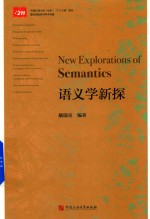
- 戴瑞亮编著 著
- 出版社: 东营:石油大学出版社
- ISBN:9787563653645
- 出版时间:2016
- 标注页数:318页
- 文件大小:39MB
- 文件页数:334页
- 主题词:语义学-研究
PDF下载
下载说明
语义学新探PDF格式电子书版下载
下载的文件为RAR压缩包。需要使用解压软件进行解压得到PDF格式图书。建议使用BT下载工具Free Download Manager进行下载,简称FDM(免费,没有广告,支持多平台)。本站资源全部打包为BT种子。所以需要使用专业的BT下载软件进行下载。如 BitComet qBittorrent uTorrent等BT下载工具。迅雷目前由于本站不是热门资源。不推荐使用!后期资源热门了。安装了迅雷也可以迅雷进行下载!
(文件页数 要大于 标注页数,上中下等多册电子书除外)
注意:本站所有压缩包均有解压码: 点击下载压缩包解压工具
图书目录
Chapter 1 Semantics in linguistics 1
1.1 Definition of semantics 1
1.2 Semantics and semiotics 1
1.3 Semantics and pragmatics 2
1.4 Some important assumptions 2
1.4.1 Reference and sense 3
1.4.2 Utterances,sentences and propositions 4
1.4.3 Sentence meaning and utterance meaning 6
1.4.4 Literal and non-literal meaning 7
1.4.5 Refer and denote 9
1.4.6 Referents and extensions 9
1.4.7 Conceptual meaning and associative meaning 9
1.5 Meanings of meaning 10
1.5.1 The referential theory:meaning as naming 10
1.5.2 Conceptualism:meaning as concept 11
1.5.3 Contextualism:meaning as context 13
1.5.4 Behaviorism:meaning as behavior 14
1.6 Summary 15
Chapter 2 Language,thought and reality 16
2.1 Language and thought 16
2.1.1 Language determines thought 16
2.1.2 Thought determines language 25
2.1.3 The language Of thought hypothesis 26
2.2 Thought and reality 27
2.3 Language and reality 28
2.4 Summary 29
Chapter 3 Word meaning 31
3.1 What is a word? 31
3.2 Lexical ambiguity and vagueness 33
3.3 Sense relations 36
3.3.1 Synonymy 36
3.3.2 Antonymy 37
3.3.3 Hyponymy 39
3.3.4 Homonymy 40
3.3.5 Polysemy 41
3.3.6 Meronymy 42
3.3.7 Member—collectiOn 43
3.3.8 Portion—mass 43
3.4 Summary 44
Chapter 4 Sentence relations and truth 45
4.1 Logic and truth 45
4.2 Necessary truth,a priori truth and analyticity 50
4.3 Entailment 53
4.4 Presupposition 56
4.4.1 Two approaches to presupposition 57
4.4.2 Presupposition failure 59
4.4.3 Presupposition triggers 60
4.4.4 Presuppositions and context 63
4.5 Summary 65
Chapter 5 Sentence semantics 1:situations 66
5.1 Situation types 66
5.2 Verbs and situation types 67
5.2.1 Stative verbs 68
5.2.2 Dynamic verbs 69
5.3 A system Of situation types 72
5.4 Modality and evidentiality 73
5.4.1 Modality 73
5.4.2 Interpretations of some modal verbs 78
5.4.3 Evidentiality 81
5.5 Summary 82
Chapter 6 Sentence semantics 2:thematic roles 83
6.1 Thematic roles 84
6.2 Identification of thematic roles 86
6.3 Grammatical relations and thematic roles 87
6.4 Problems with thematic roles 89
6.5 The motivation for identifying thematic roles 92
6.6 Voice 93
6.7 Summary 94
Chapter 7 Context and inference:a pragmatic study of meaning 1 96
7.1 Deixis 96
7.1.1 Place deixis 97
7.1.2 Person deixis 99
7.1.3 Time deixis 100
7.1.4 Discourse deixis 101
7.1.5 Social deixis 102
7.1.6 Grammaticalization of contextual information 102
7.1.7 Metaphorical relationship between space,time and discourse deixis 103
7.2 Reference and context 104
7.3 Knowledge as context 106
7.3.1 Situation as context 106
7.3.2 Discourse as context 107
7.3.3 Background knowledge as context 110
7.3.4 Giving background knowledge to computers 111
7.4 Information structure 113
7.5 Inference 117
7.6 Conversational implicature 125
7.6.1 Grice's Cooperative Principle 125
7.6.2 Post-Gricean developments 133
7.7 Summary 143
Chapter 8 Speech act theory:a pragmatic study Of meaning 2 145
8.1 Austin's Speech Act Theory 148
8.1.1 The performative-constative dichotomy 148
8.1.2 Felicity conditions 150
8.1.3 Collapse of the dichotomy 152
8.1.4 Atheory of illocutionary act 153
8.2 Searle's theory of speech acts 154
8.3 Indirect speech acts 158
8.4 Indirect speech acts and politeness 161
8.5 Summary 163
Chapter 9 Decomposition of meaning 164
9.1 Componential analysis 164
9.2 Katz's semantic theory 169
9.2.1 The Katzian dictionary 170
9.2.2 Projection rules 171
9.3 Components and conflation patterns 174
9.4 Conflation patterns Of motion verbs in English and Chinese 177
9.4.1 Conflation patterns of manner verbs in English and Chinese 177
9.4.2 Conflation patterns of path verbs in English and Chinese 183
9.5 Predication analysis 188
9.6 Summary 189
Chapter 10 Cognitive semantics 190
10.1 Metaphor and metonymy 193
10.1.1 Metaphor 193
10.1.2 Metonymy 205
10.1.3 Metaphor-metonymy interaction 212
10.2 Image schema 214
10.2.1 Containment schema 216
10.2.2 Path schema 219
10.2.3 Force schema 220
10.3 Polysemy 223
10.3.1 Prepositions 223
10.3.2 Modal verbs 227
10.4 Categorization and idealized cognitive models 230
10.4.1 Categorization 230
10.4.2 Idealized cognitive models 238
10.5 Iconicity 250
10.5.1 Iconicity of order 251
10.5.2 Iconicity of distance 259
10.5.3 Iconicity of quantity 265
10.5.4 Philosophical interpretation of iconicity 270
10.5.5 Iconicity and Other competing principles 272
10.6 Mental spaces 276
10.6.1 Connections between spaces 280
10.6.2 Referential opacity 283
10.6.3 Presupposition 287
10.7 Conceptual blending 288
10.7.1 The Origins of Blending Theory 290
10.7.2 Towards a theory of conceptual integration 291
10.7.3 The nature of blending 297
10.7.4 Contrasting Blending Theory with Conceptual Metaphor Theory 304
10.8 Grammaticalization 306
10.9 Summary 309
Bibliography 311