
图书介绍
语篇中的衔接和语篇主旨大意的关系 英文pdf电子书版本下载
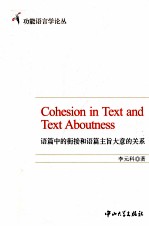
- 李元科著 著
- 出版社: 广州:中山大学出版社
- ISBN:7306042538
- 出版时间:2012
- 标注页数:258页
- 文件大小:9MB
- 文件页数:272页
- 主题词:功能(语言学)-研究-英语-
PDF下载
下载说明
语篇中的衔接和语篇主旨大意的关系 英文PDF格式电子书版下载
下载的文件为RAR压缩包。需要使用解压软件进行解压得到PDF格式图书。建议使用BT下载工具Free Download Manager进行下载,简称FDM(免费,没有广告,支持多平台)。本站资源全部打包为BT种子。所以需要使用专业的BT下载软件进行下载。如 BitComet qBittorrent uTorrent等BT下载工具。迅雷目前由于本站不是热门资源。不推荐使用!后期资源热门了。安装了迅雷也可以迅雷进行下载!
(文件页数 要大于 标注页数,上中下等多册电子书除外)
注意:本站所有压缩包均有解压码: 点击下载压缩包解压工具
图书目录
Chapter 1 Introduction 1
1.1 A short review of studies on cohesion and of aspects of cohesion that have not been explored sufficiently 1
1.2 The aim of my present study 3
1.3 The organization of the book 4
Chapter 2 Literature Background 7
2.1 Introduction 7
2.2 Hasan(1984)and Halliday and Hasan(1985) 7
2.3 The limitations of Hasan's method and improvements 20
2.4 Parsons(1991a,1991b) 36
2.5 Hoey(1991) 41
2.6 Scott's Key Words tool 48
2.7 Hoey's(2001) Textual Interaction 51
2.8 Mann and Thompson's(1988a,1988b)Rhetorical Structure Theory 56
2.9 Conclusions 62
Chapter 3 Research Question 1 and the Method 64
3.1 Introduction 64
3.2 Research question 1 and the data 64
3.3 The method used to explore research question 1 66
3.3.1 Classifying processes in a text into chains according to the commonality of meanings they express 67
3.3.2 Unpacking in text nominalizations that contain nominalised processes included in chains 85
3.3.3 Identifying recurrent nuclei in text 120
3.3.4 Ranking the recurrent nuclei in text in descending order of frequency 127
3.3.5 Classifying processes in summaries into chains according to the commonality of meanings they express 128
3.3.6 Unpacking in summaries nominalizations that contain nominalised processes included in chains 134
3.3.7 Identifying recurrent nuclei in summaries 141
3.3.8 Comparing the results in A4 with that in B3 to identify the recurrent nuclei in text that are repeated in two or more summaries of the text 142
Chapter 4 Findings with Regard to Research Question 1 143
4.1 Introduction 143
4.2 The results with regard to research question 1 143
4.3 The characteristics of the recurrent nuclei in texts that are important to the texts' meanings 151
4.3.1 Category 1 151
4.3.2 Categories 1(c),2 and 3(b) 159
4.3.3 Subcategory 3(a) 164
4.3.4 The probability of presence in the leads of the recurrent nuclei that are important to texts' meanings 167
4.3.5 Category 4 168
4.4 Conclusions 173
Chapter 5 Research Question 2 and Findings 177
5.1 Introduction 177
5.2 The definitions of type A and type B nuclei 177
5.3 Research question 2 and the method of exploring the question 179
5.4 The results with regard to research question 2 191
5.5 Examining the‘maverick' cases 196
5.5.1 The seven initial occurrences of type A material nuclei that express causes 196
5.5.2 The four initial occurrences of type A material nuclei that are part of the content of saying of verbal nuclei 203
5.5.3(a) The initial occurrences of two type A material nuclei that contextualize 208
5.5.3(b) The six initial occurrences of type B material nuclei that also contextualize 211
5.5.4 Proposition splitting 217
5.5.5 Inference 222
5.5.6 Proposition integration 227
5.5.7 Reduction 228
5.5.8 The remaining and final example 231
5.6 Conclusions 232
Chapter 6 Conclusions 236
6.1 Introduction 236
6.2 Areas of innovation and contribution of my present study 236
6.3 Patterns of lexis in a text and the meaning of the text 237
6.4 Information distribution in the leads 239
6.5 The strategies that summary writers often use to write summaries for hard news texts 241
6.6 Conjunctive relations and the meaning of a text 242
6.7 Future research avenues 246
Appendix A 250
Appendix B 252
References 253