
图书介绍
中国英语学习者语调习得研究 语调重音与曲拱的语音和音系分析pdf电子书版本下载
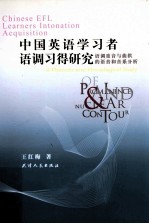
- 王红梅著 著
- 出版社: 天津:天津人民出版社
- ISBN:9787201059971
- 出版时间:2008
- 标注页数:278页
- 文件大小:13MB
- 文件页数:304页
- 主题词:
PDF下载
下载说明
中国英语学习者语调习得研究 语调重音与曲拱的语音和音系分析PDF格式电子书版下载
下载的文件为RAR压缩包。需要使用解压软件进行解压得到PDF格式图书。建议使用BT下载工具Free Download Manager进行下载,简称FDM(免费,没有广告,支持多平台)。本站资源全部打包为BT种子。所以需要使用专业的BT下载软件进行下载。如 BitComet qBittorrent uTorrent等BT下载工具。迅雷目前由于本站不是热门资源。不推荐使用!后期资源热门了。安装了迅雷也可以迅雷进行下载!
(文件页数 要大于 标注页数,上中下等多册电子书除外)
注意:本站所有压缩包均有解压码: 点击下载压缩包解压工具
图书目录
Chapter One Introduction 1
1.1 Research background 1
1.2 Purpose of the study 5
1.3 Significance of the study 7
1.4 Organization 9
Chapter Two Literature Review 11
2.1 Approaches to English intonation 12
2.1.1 The British configurational approach 12
2.1.2 The American level approach 14
2.1.3 The IPO approach 15
2.1.4 The AM approach 16
2.1.4.1 Fundamental principle of the AM approach 16
2.1.4.2 Stress analysis in the AM approach 19
2.2 English prominence distribution rule 22
2.2.1 Content words and function words 22
2.2.2 Nuclear stress rule(NSR)by Chomsky and Halle(1968) 23
2.3 Intonation characteristics of English and Chinese 26
2.3.1 Intonation characteristics of English 26
2.3.1.1 Vowel compression and truncation 26
2.3.1.2 Prominence grid 27
2.3.1.3 Tendency toward isochrony 29
2.3.2 Characteristics of Chinese intonation 30
2.3.2.1 Tones in Chinese 30
2.3.2.2 Syllable-timed language 31
2.3.2.3 Sentence intonation and word tonal contour interaction 32
2.3.2.4 Pitch range variation 33
2.3.3 Problems in intonation acquisition for Chinese learners 33
2.4 OT and Learnability 35
2.4.1 OT basics 35
2.4.2 Intonation in OT 38
2.4.3 Learnabilitv issue in OT 39
2.5 Relevant studies on English intonation acquisition 41
2.5.1 Previous researches on English intonation in SLA 41
2.5.2 Previous researches on Chinese learners 45
2.6 Summary 50
Chapter Three Research Design 52
3.1 Research questions 52
3.2 Subjects 54
3.2.1 Chinese learners of English 54
3.2.2 British speakers 55
3.3 Reading material and experiment sentences 56
3.3.1 Reading material 56
3.3.2 Experiment sentences 57
3.4 Read speech corpus 58
3.4.1 Selection of the native speakers'recordings 58
3.4.2 Recordings of Chinese learners 59
3.5 Scoring and group division 60
3.5.1 Scoring and correlation among the six scorers 60
3.5.2 Group division 62
3.6 Labeling the recorded material 64
3.6.1 Labeling instrument 64
3.6.2 Labeling system 65
3.6.3 Labeling procedure 71
3.6.4 Prominence identification 73
3.6.4.1 Pitch accent identification 74
3.6.4.2 Intensity and duration identification 75
3.6.4.3 Semantic cues in prominence identification 76
Chapter Four Prominence Analysis and Discussion 79
4.1 Introduction 79
4.2 Prominence in declarative sentence 80
4.2.1 The British speakers 80
4.2.2 The high group of Chinese learners 82
4.2.3 The low group of Chinese learners 84
4.2.4 Comparative analysis 86
4.3 Prominence in exclamatory sentence 90
4.3.1 The British speakers 90
4.3.2 The high group of Chinese learners 92
4.3.3 The low group of Chinese learners 93
4.3.4 Comparative analysis 94
4.4 Prominence in imperative sentence 97
4.4.1 The British speaker 97
4.4.2 The high group of Chinese learners 98
4.4.3 The low group of Chinese learners 100
4.4.4 Comparative analysis 101
4.5 Prominence in tag question 103
4.5.1 The British speakers 104
4.5.2 The high group of Chinese learners 105
4.5.3 The low group of Chinese learners 106
4.5.4 Comparative analysis 108
4.6 Prominence in yes/no question 111
4.6.1 The British speakers 111
4.6.2 The high group of Chinese learners 113
4.6.3 The low group of Chinese learners 114
4.6.4 Comparative analysis 115
4.7 Prominence in wh-question 119
4.7.1 The British speakers 119
4.7.2 The high group of Chinese learners 120
4.7.3 The low group of Chinese learners 121
4.7.4 Comparative analysis 123
4.8 Prominence in declarative question 126
4.8.1 The British speakers 126
4.8.2 The high group of Chinese learners 128
4.8.3 The low group of Chinese learners 129
4.8.4 Comparative analysis 130
4.9 Discussion 133
4.9.1 Number of stressed words 133
4.9.2 Shared prominence patterns 135
4.9.3 Distinctive prominence patterns 136
4.9.4 Fitness test between the learners and the NS 138
4.10 Summary 141
Chapter Five Nuclear Contour Pattern Analysis 143
5.1 Introduction 143
5.2 Nuclear contour in declarative sentence 145
5.3 Nuclear contour in exclamatory sentence 147
5.4 Nuclear contour in imperative sentence 149
5.5 Nuclear contour in tag-question 151
5.6 Nuclear contour in yes/no-question 153
5.7 Nuclear contour in wh-question 155
5.8 Nuclear contour in declarative question 157
5.9 Discussion 159
5.9.1 Universals about English nuclear contour patterns 159
5.9.2 Nuclear contour patterns for the NS 162
5.9.3 Nuclear contour patterns for the Chinese learners 167
5.9.3.1 Chi-square test of the nuclear contour patterns 168
5.9.3.2 Recoded nuclear contour patterns 170
5.10 Summary 174
Chapter Six An OT Diagnosis 175
6.1 Introduction 175
6.2 An OT diagnosis on prominence distribution patterning 176
6.2.1 Prominence distribution patterning for the NS 176
6.2.1.1 Prominence constraint ranking for the NS 176
6.2.1.2 OT diagnosis on seven sentences 178
6.2.2 Prominence distribution patterning for the Chinese learners 189
6.2.2.1 Prominence constraint ranking for the Chinese learners 189
6.2.2.2 OT diagnosis on seven sentences 190
6.3 An OT diagnosis on nuclear contour structure 210
6.3.1 Nuclear contour finite-state grammar 210
6.3.2 The OT analysis of nuclear contour structure 211
6.4 Summary 214
Chapter Seven Conclusions 215
7.1 Major findings 215
7.2 Contributions 218
7.3 Implications 220
7.4 Limitations and further studies 223
Bibliography 225
Appendix A Reading passage 246
Appendix B Scores for the HG and the LG 249
Appendix C Speech spectrum of the NS samples 251
Appendix D Speech spectrum of the learner samples 255
Appendix E Prominence fitness in read speech 262
Appendix F Nuclear contour Chi-square test in read speech 265