
图书介绍
经典和现代回归分析及其应用 第2版pdf电子书版本下载
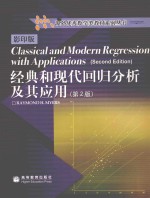
- (美)麦尔斯(Myers,R.H.)著 著
- 出版社: 北京:高等教育出版社
- ISBN:7040163233
- 出版时间:2005
- 标注页数:489页
- 文件大小:69MB
- 文件页数:501页
- 主题词:
PDF下载
下载说明
经典和现代回归分析及其应用 第2版PDF格式电子书版下载
下载的文件为RAR压缩包。需要使用解压软件进行解压得到PDF格式图书。建议使用BT下载工具Free Download Manager进行下载,简称FDM(免费,没有广告,支持多平台)。本站资源全部打包为BT种子。所以需要使用专业的BT下载软件进行下载。如 BitComet qBittorrent uTorrent等BT下载工具。迅雷目前由于本站不是热门资源。不推荐使用!后期资源热门了。安装了迅雷也可以迅雷进行下载!
(文件页数 要大于 标注页数,上中下等多册电子书除外)
注意:本站所有压缩包均有解压码: 点击下载压缩包解压工具
图书目录
CHAPTER 1 INTRODUCTION:REGRESSION ANALYSIS 1
1.1 Regression models 3
1.2 Formal uses of regression analysis 5
1.3 The data base 6
References 7
CHAPTER 2 THE SIMPLE LINEAR REGRESSION MODEL 8
2.1 The model description 8
2.2 Assumptions and interpretation of model parameters 9
2.3 Least squares formulation 12
2.4 Maximum likelihood estimation 20
2.5 Partioning total variability 22
2.6 Tests of hypothesis on slope and intercept 26
2.7 Simple regression through the origin(Fixed intercept) 33
2.8 Quality of fitted model 37
2.9 Confidence intervals on mean response and prediction intervals 41
2.10 Simultaneous inference in simple linear regression 47
2.11 A complete annotated computer printout 56
2.12 A look at residuals 57
2.13 Both x and y random 66
Exercises 72
References 80
CHAPTER 3 THE MULTIPLE LINEAR REGRESSION MODEL 82
3.1 Model description and assumptions 82
3.2 The general linear model and the least squares procedure 85
3.3 Properties of least squares estimators under ideal conditions 91
3.4 Hypothesis testing in multiple linear regression 95
3.5 Confidence intervals and prediction intervals in multiple regressions 112
3.6 Data with repeated observations 116
3.7 Simultaneous inference in multiple regression 120
3.8 Multicollinearity in multiple regression data 123
3.9 Quality fit,quality prediction,and the HAT matrix 133
3.10 Categorical or indicator variables(Regression models and ANOVA models) 135
Exercises 153
References 163
CHAPTER 4 CRITERIA FOR CHOICE OF BEST MODEL 164
4.1 Standard criteria for comparing models 165
4.2 Cross validation for model selection and determination of model performance 167
4.3 Conceptual predictive criteria(The Cp=statistic) 178
4.4 Sequential variable selection procedures 185
4.5 Further comments and all possible regressions 193
Exercises 199
References 206
CHAPTER 5 ANALYSIS OF RESIDUALS 209
5.1 Information retrieved from residuals 210
5.2 Plotting of residuals 211
5.3 Studentized residuals 217
5.4 Relation to standardized PRESS residuals 220
5.5 Detection of outliers 221
5.6 Diagnostic plots 231
5.7 Normal residual plots 242
5.8 Further comments on analysis of residuals 244
Exercises 244
References 248
CHAPTER 6 INFLUENCE DIAGNOSTICS 249
6.1 Sources of influence 250
6.2 Diagnostics:Residuals and the HAT matrix 251
6.3 Diagnostics that determine extent of influence 257
6.4 Influence on performance 267
6.5 What do we do with high influence points? 270
Exercises 272
References 273
CHAPTER 7 NONSTANDARD CONDITIONS,VIOLATIONS OF ASSUMPTIONS,AND TRANSFORMATIONS 275
7.1 Heterogeneous variance:Weighted least squares 277
7.2 Problem with correlated errors(Autocorrelation) 287
7.3 Transformations to improve fit and prediction 293
7.4 Regression with a binary response 315
7.5 Further developments in models with a discrete response(Poisson regression) 332
7.6 Generalized linear models 339
7.7 Failure of normality assumption:Presence of outliers 348
7.8 Measurement errors in the regressor variables 357
Exercises 358
References 365
CHAPTER 8 DETECTING AND COMBATING MULTICOLLINEARITY 368
8.1 Multicollinearitv diagnostics 369
8.2 Variance proportions 371
8.3 Further topics concerning multicollinearity 379
8.4 Alternatives to least squares in cases of multicollinea ritv 389
Exercises 419
References 422
CHAPTER 9 NONLINEAR REGRESSION 424
9.1 Nonlinear least squares 425
9.2 Properties of the least squares estimators 425
9.3 The Gauss-Newton procedure for finding estimates 426
9.4 Other modifications of the Gauss-Newton procedure 433
9.5 Some special classes of nonlinear models 436
9.6 Further considerations in nonlinear regression 440
9.7 Why not transform data to 1inearize? 444
Exercises 445
References 449
APPENDIX A SOME SPECIAL CONCEPTS IN MATRIXALGEBRA 452
A.1 Solutions to simultaneous linear equations 452
A.2 Quadratic form 454
A.3 Eigenvalues and eigenvectors 456
A.4 The inverses of a partitioned matrix 458
A.5 Sherman-Morrison-Woodbury theorem 459
References 460
APPENDIX B SOME SPECIAL MANIPULATIONS 461
B.1 Unbiasedness of the residual mean square 461
B.2 Expected value of residual sum of squares and mean square for an underspecified model 462
B.3 The maximum likelihood estimator 464
B.4 Development of the PRESS statistic 465
B.5 Computation of s-i 467
B.6 Dominance of a residual by the corresponding model error 468
B.7 Computation of influence diagnostics 468
B.8 Maximum likelihood estimator in the nonlinear model 470
B.9 Taylor series 470
B.10 Development of the C?-statistic 471
References 473
APPENDIX C STATISTICAL TABLES 474
INDEX 486