
图书介绍
图像分析、随机场和动态蒙特卡罗方法pdf电子书版本下载
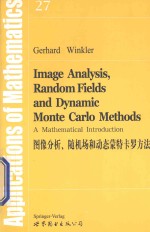
- Gerhard Winkler著 著
- 出版社: 世界图书出版公司北京公司
- ISBN:750623825X
- 出版时间:1999
- 标注页数:324页
- 文件大小:43MB
- 文件页数:337页
- 主题词:
PDF下载
下载说明
图像分析、随机场和动态蒙特卡罗方法PDF格式电子书版下载
下载的文件为RAR压缩包。需要使用解压软件进行解压得到PDF格式图书。建议使用BT下载工具Free Download Manager进行下载,简称FDM(免费,没有广告,支持多平台)。本站资源全部打包为BT种子。所以需要使用专业的BT下载软件进行下载。如 BitComet qBittorrent uTorrent等BT下载工具。迅雷目前由于本站不是热门资源。不推荐使用!后期资源热门了。安装了迅雷也可以迅雷进行下载!
(文件页数 要大于 标注页数,上中下等多册电子书除外)
注意:本站所有压缩包均有解压码: 点击下载压缩包解压工具
图书目录
Introduction 1
Part Ⅰ.Bayesian Image Analysis:Introduction 13
1.The Bayesian Paradigm 13
1.1 The Space of Images 13
1.2 The Space of Observations 15
1.3 Prior and Posterior Distribution 16
1.4 Bayesian Decision Rules 19
2.Cleaning Dirty Pictures 23
2.1 Distortion of Images 23
2.1.1 Physical Digital Imaging Systems 23
2.1.2 Posterior Distributions 26
2.2 Smoothing 29
2.3 Piecewise Smoothing 35
2.4 Boundary Extraction 43
3.Random Fields 47
3.1 Markov Random Fields 47
3 2 Gibbs Fields and Potentials 51
3.3 More on Potentials 57
Part Ⅱ.The Gibbs Sampler and Simulated Annealing 65
4.Markov Chains:Limit Theorems 65
4.1 Preliminaries 65
4.2 The Contraction Coefficient 69
4.3 Homogeneous Markov Chains 73
4.4 Inhomogeneous Markov Chains 76
5.Sampling and Annealing 81
5.1 Sampling 81
5.2 Simulated Annealing 88
5.3 Discussion 94
6.Cooling Schedules 99
6.1 The ICM Algorithm 99
6.2 Exact MAPE Versus Fast Cooling 102
6.3 Finite Time Annealing 111
7.Sampling and Annealing Revisited 113
7.1 A Law of Large Numbers for Inhomogeneous Markov Chains 113
7.1.1 The Law of Large Numbers 113
7.1.2 A Counterexample 118
7.2 A General Theorem 121
7.3 Sampling and Annealing under Constraints 125
7.3.1 Simulated Annealing 126
7.3.2 Simulated Annealing under Constraints 127
7.3.3 Sampling with and without Constraints 129
Part Ⅲ.More on Sampling and Annealing 133
8.Metropolis Algorithms 133
8.1 The Metropolis Sampler 133
8.2 Convergence Theorems 134
8.3 Best Constants 139
8.4 About Visiting Schemes 141
8.4.1 Systematic Sweep Strategies 141
8.4.2 The Influence of Proposal Matrices 143
8.5 The Metropolis Algorithm in Combinatorial Optimization 148
8.6 Generalizations and Modifications 151
8.6.1 Metropolis-Hastings Algorithms 151
8.6.2 Threshold Random Search 153
9.Alternative Approaches 155
9.1 Second Largest Eigenvalues 155
9.1.1 Convergence Reproved 155
9.1.2 Sampling and Second Largest Eigenvalues 159
9.1.3 Continuous Time and Space 163
10.Parallel Algorithms 167
10.1 Partially Parallel Algorithms 168
10.1.1 Synchroneous Updating on Independent Sets 168
10.1.2 The Swendson-Wang Algorithm 171
10.2 Synchroneous Algorithms 173
10.2.1 Introduction 173
10.2.2 Invariant Distributions and Convergence 174
10.2.3 Support of the Limit Distribution 178
10.3 Synchroneous Algorithms and Reversibility 182
10.3.1 Preliminaries 183
10.3.2 Invariance and Reversibility 185
10.3.3 Final Remarks 189
Part Ⅳ.Texture Analysis 195
11.Partitioning 195
11.1 Introduction 195
11.2 How to Tell Textures Apart 195
11.3 Features 196
11.4 Bayesian Texture Segmentation 198
11.4.1 The Features 198
11.4.2 The Kolmogorov-Smirnov Distance 199
11.4.3 A Partition Model 199
11.4.4 Optimization 201
11.4.5 A Boundary Model 203
11.5 Julesz's Conjecture 205
11.5.1 Introduction 205
11.5.2 Point Processes 205
12.Texture Models and Classification 209
12.1 Introduction 209
12.2 Texture Models 210
12.2.1 The φ-Model 210
12.2.2 The Autobinomial Model 211
12.2.3 Automodels 213
12.3 Texture Synthesis 214
12.4 Texture Classification 216
12.4.1 General Remarks 216
12.4.2 Contextual Classification 218
12.4.3 MPM Methods 219
Part Ⅴ.Parameter Estimation 225
13.Maximum Likelihood Estimators 225
13.1 Introduction 225
13.2 The Likelihood Function 225
13.3 Objective Functions 230
13.4 Asymptotic Consistency 233
14.Spacial ML Estimation 237
14.1 Introduction 237
14.2 Increasing Observation Windows 237
14.3 The Pseudolikelihood Method 239
14.4 The Maximum Likelihood Method 246
14.5 Computation of ML Estimators 247
14.6 Partially Observed Data 253
Part Ⅵ.Supplement 257
15.A Glance at Neural Networks 257
15.1 Introduction 257
15.2 Boltzmann Machines 257
15.3 A Learning Rule 262
16.Mixed Applications 269
16.1 Motion 269
16.2 Tomographic Image Reconstruction 274
16.3 Biological Shape 276
Part Ⅶ.Appendix 283
A.Simulation of Random Variables 283
A.1 Pseudo-random Numbers 283
A.2 Discrete Random Variables 286
A.3 Local Gibbs Samplers 289
A.4 Further Distributions 290
A.4.1 Binomial Variables 290
A.4.2 Poisson Variables 292
A.4.3 Gaussian Variables 293
A.4.4 The Rejection Method 296
A.4.5 The Polar Method 297
B.The Perron-Frobenius Theorem 299
C.Concave Functions 301
D.A Global Convergence Theorem for Descent Algorithms 305
References 307
Index 321