
图书介绍
构建可扩展数据库应用程序pdf电子书版本下载
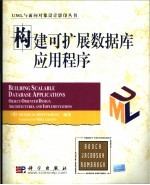
- (美)海金斯(Heinckiens,P.M.)编著 著
- 出版社: 北京:科学出版社
- ISBN:7030124936
- 出版时间:2004
- 标注页数:311页
- 文件大小:11MB
- 文件页数:332页
- 主题词:数据库系统-程序设计-英文
PDF下载
下载说明
构建可扩展数据库应用程序PDF格式电子书版下载
下载的文件为RAR压缩包。需要使用解压软件进行解压得到PDF格式图书。建议使用BT下载工具Free Download Manager进行下载,简称FDM(免费,没有广告,支持多平台)。本站资源全部打包为BT种子。所以需要使用专业的BT下载软件进行下载。如 BitComet qBittorrent uTorrent等BT下载工具。迅雷目前由于本站不是热门资源。不推荐使用!后期资源热门了。安装了迅雷也可以迅雷进行下载!
(文件页数 要大于 标注页数,上中下等多册电子书除外)
注意:本站所有压缩包均有解压码: 点击下载压缩包解压工具
图书目录
3.5 Example:Student Administration 3 1
Part One An Object-Oriented View on Persistence 1
Chapter 1 A New Generation of Software 3
1.1 FromDatatoInformation 3
1.2 Improving Software Quality 4
1.3 Databases Everywhere 4
1.4 ToHave andtoHold 5
1.5 Concentrating on the Essence 5
1.6 The Importance of Scalability 6
1.7 Application Program Interfaces 7
1.8 TheRoadtoFollow 7
2.1 Walking among Dinosaurs 9
Chapter 2 The Database Community Today 9
2.3 Database Users 10
2.2 Database Usage 10
2.4 Designing Database Applications 11
Contents 11
Foreword 11
2.5 Relational Databases 12
Preface 13
2.6 Client/Server Systems 15
Acknowledgments 17
2.7 Distributed Software 18
2.8 Problems with Traditional Systems 19
About theAuthor 19
2.9 4GL:The Solution? 20
2.10 Object-Oriented Databases 21
2.11 Preserving Openness 23
2.12 Summary 24
3.1 Data-Driven Software Design 25
Chapter 3 An Object-Oriented View on Database Applications 25
3.2 Supporting Multiple Applications 28
3.3 Object-Oriented Software Design 29
3.4 The Object Model 30
3.6 Business Models and Supporting Multiple Applications 34
3.7 C++,Java,or Smalltalk:The Ultimate Answer? 35
3.8 Building Reusable Software 38
3.11 User Interfaces 40
3.10 Object Orientation and Client/Server Design 40
3.9 Toward Open Client/Server Applications 40
3.12 Analogy between User Interfaces and Databases 41
3.13 Object-Oriented or Relational? 43
3.14 Persistence from a Different Angle 44
3.15 Persistence and Separation of Concerns 44
3.16 Safety Issues 46
3.17 Summary 46
Part Two An Architecture for Object Persistence 47
4.1 Introduction 49
Chapter 4 Making Objects Persistent 49
4.2 Basic Requirements of a Persistence Framework 50
4.3 Obtaining Scalability 50
4.4 Interfacing with a Relational World:Problems to Conquer 51
4.5 Abstracting the Database 57
4.6 An Architecture for Object Persistence 58
4.7 Summary 60
5.1 A Persistent Container Class 61
5.2 Basic Functionality of PSet 61
Chapter 5 Abstracting the Database 61
5.3 Implementing the Persistence Architecture 63
5.4 Resolving the Impedance Mismatch 65
5.5 Reading and Writing Objects 71
5.6 Direct Instances of PSet 73
5.7 Searching for Objects 75
5.8 Supporting Multiple Technologies 79
5.9 Summary 81
6.1 Deriving from PSet 83
Chapter 6 Encapsulating Data Access 83
6.2 Example:Class City 87
6.3 Using Class City 93
6.4 Member Objects 93
6.5 Derived IM Resolvers 94
6.6 Class Extension 99
6.7 Compile-Time Decoupling 100
6.8 Reuse and Migration to Other Technologies 104
6.9 Summary 104
Part Three Implementing Business Models 105
7.1 Developing a Simple Invoicing System 107
Chapter 7 Designing Business Objects 107
7.2 Searching Compound Objects 116
7.3 Object ID versus Primary Key 118
7.4 Developing Generic IM Resolvers 121
7.5 An OID-Based Reference Class 126
7.6 Supporting Existing Database Layouts 130
7.7 Versioning 131
7.8 Stability of Program Code against Schema Changes 134
7.9 Storing Multimedia Objects 135
7.10 Efficiency 139
7.11 Summary 145
Chapter 8 Inheritance of Persistent Objects 147
8.1 Specialization:Using Inheritance for Reuse 147
8.2 Generalization:Using Inheritance for Polymorphism 152
8.3 Using Generalizations as Member Objects 158
8.4 Inheritance in Relational Database Systems 162
8.5 Designing Reusable Software Components 170
8.6 Summary 173
9.1 Many-to-One Relationships 175
Chapter 9 Associations 175
9.2 Attributes versus Associations 176
9.3 Collections:One-to-Many Relationships 178
9.4 Associations and Reuse 186
9.5 Many-to-Many Relationships 188
9.6 A Closer Look at Associations 189
9.7 Associations as Independent Entities 191
9.8 Referential Integrity 197
9.9 Summary 202
10.2 The ACID Test 203
Chapter 10 Transaction Management and Concurrency Control 203
10.1 The Transaction 203
10.3 Transaction Management Exceeds the Database Level 205
10.4 Concurrency Control:Locking 206
10.5 Example:A Transaction Class 211
10.6 Transactions in Relational Database Systems 212
10.7 Using Transactions 214
10.8 Nested Transactions 215
10.9 Distributed DatabaseSystems 217
10.10 Other Levels ofConcurrency 219
10.11 Lock Notification through Call-Back Functions 221
10.12 Summary 222
Chapter 11 The Front End 223
11.1 Analogy between User Interfaces and Databases 223
11.2 Separating the User Interface from the Business Model 223
11.3 WhattoPutWhere 229
11.4 Navigating through Persistent Sets 229
11.5 Summary 234
12.1 ProjectDefinition 235
Chapter 12 Case Study:An Electronic Telephone Directory 235
12.2 Comparing Development Approaches 236
12.3 Designing the User Interface 237
12.4 The Database Model 240
12.5 Designing the Business Model 240
12.6 Comparing the Business Model and the Database Model 243
12.7 Implementing the Business Objects 244
12.8 Making Classes Persistent 250
12.9 Impedance Mismatch Examples 257
12.10 Implementing the User Interface 263
12.11 Summary 275
Chapter 13 Toward Open Applications 277
13.1 Third-Party Access to Your Application's Data 278
13.2 Standard Report Generators and Query Tools 278
13.3 Informationbases 281
13.4 Interoperability with Other Applications 282
13.5 Implementing an Informationbase 285
13.6 Architecture for Next-Generation Software 286
13.7 Summary 289
Chapter 14 Conclusion 291
Appendix DBtools-Based Implementation of Scoop 293
PSet 293
DataSet 294
IM Resolver 294
Resolving Impedance Mismatch 295
Building the Select Statement 296
References 297
Index 301