
图书介绍
LEGAL POLICY ANALYSIS FINDING AN OPTIMUM LEVEL OR MIXpdf电子书版本下载
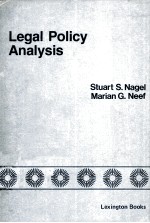
- 著
- 出版社: LEXINGTON OOKS
- ISBN:0669007315
- 出版时间:1977
- 标注页数:329页
- 文件大小:14MB
- 文件页数:347页
- 主题词:
PDF下载
下载说明
LEGAL POLICY ANALYSIS FINDING AN OPTIMUM LEVEL OR MIXPDF格式电子书版下载
下载的文件为RAR压缩包。需要使用解压软件进行解压得到PDF格式图书。建议使用BT下载工具Free Download Manager进行下载,简称FDM(免费,没有广告,支持多平台)。本站资源全部打包为BT种子。所以需要使用专业的BT下载软件进行下载。如 BitComet qBittorrent uTorrent等BT下载工具。迅雷目前由于本站不是热门资源。不推荐使用!后期资源热门了。安装了迅雷也可以迅雷进行下载!
(文件页数 要大于 标注页数,上中下等多册电子书除外)
注意:本站所有压缩包均有解压码: 点击下载压缩包解压工具
图书目录
Part Ⅰ Finding an Optimum Level 1
Chapter 1 The Policy Problem of Doing Too Much or Too Little: Pretrial Release as a Case in Point 9
Ⅰ.The Problems and the Data 9
A.The Basic Problems to Resolve 9
B.The Data to Work With 10
Ⅱ.A Causal Model Showing the Effects of Increasing the Percentage of Defendants Held 15
A.The Basic Causal Model 15
B.Compared to Alternative Causal Mod-els 19
Ⅲ.Finding an Optimum Percent of Defen-dants to Hold Pending Trial 23
A.With Linear Relations among the Variables 24
B.With Nonlinear Relations among the Variables 25
C.The Bottom Point on the Total-Cost Curve 27
Ⅳ.A Causal Model Showing the Effects of Cost Changes on the Optimum Percent to Hold 29
A.Determining the Direction of the Ef-fects 30
B.Determining the Magnitude of the Ef-fects 32
C.Diagramming, Summarizing, and Indi-vidualizing the Model 34
Ⅴ.Further Policy, Causal, and Methodolog-ical Implications 37
A.The Optimum versus the Empirical 38
B.Expanded Causal Model with Further Policy Implications 43
C.Expanded Applications to Other Poli-cy Problems 46
Appendix 1A.Glossary of Terms 67
Appendix 1B.Basic Formulas Used 71
Chapter 2 Using Deductive Modeling to Determine an Opti-mum Jury Size and Fraction Required to Convict 75
Ⅰ.The Basic Problems to Resolve 75
A.Inability of Empirical Data to Indi-cate Effects of Jury Size 75
B.Deductive Analysis to Indicate Ef-fects of Jury Size 78
Ⅱ.The Basic Data to Use 79
A.The Probability of Convicting an Average Defendant 79
B.The Probability of Convicting an In-nocent or a Guilty Defendant 81
C.The Number of Innocent and Guilty Defendants per 100 Defendants 82
D.Summary and Consistency of the Ba-sic Data 84
Ⅲ.Optimizing Jury Size 85
A.Effects of Changes in Jury Size on Jury Errors 85
B.The Optimum Jury Size When Con-victions of the Innocent Are Consid-ered 10 Times as Undesirable as Nonconvictions of the Guilty 88
Ⅳ.Optimizing the Fraction Required to Convict 90
A.Effects of Changes in the Fraction Required to Convict on Jury Errors 90
B.The Optimum Fraction Required to Convict with a Trade-Off Weight of 10 93
Ⅴ.Effects of Changing the Normative and Empirical Premises 95
A.Effects of Changing the Normative Premises on the Optimum Unanimous Jury Size 95
B.Effects of Changing the Empirical Premises on the Optimum Unanimous Jury Size 99
C.Effects of Changing the Premises on the Optimum Nonunanimous Fraction Required to Convict 103
Ⅵ.The Independent-Probability Perspective versus the Collective-Mind Perspective 105
A.Calculating Conviction Probabilities Using an Unweighted Average for the Two Perspectives 106
B.Calculating Conviction Probabilities Using a Weighted Average for the Two Perspectives 107
C.Revised Data and Results 110
Ⅶ.Variations on the Basic Model 115
A.Effect of Jury Size on Representa-tiveness that Affects Conviction Probabilities 115
B.Other Variations 118
Ⅷ.Conclusions 126
Appendix 2A.Glossary of Terms 151
Appendix 2B.Basic Formulas Used 155
Appendix 2C.The Impact of Jury Size on the Probability of Conviction 157
Part Ⅱ Finding an Optimum Mix among Competing Policies 159
Chapter 3 Developing an Optimum-Mix Strategy for Civil Rights or Other Multipolicy Activities 163
Ⅰ.Basic Ideas 163
A.The General Purposes and the Data 163
B.The Substantive Problem and the Ba-sic Methodology 164
Ⅱ.Scoring the Cities and the Activities 165
Ⅲ.Finding an Optimum Mix between Two Civil Rights Activities 171
A.Equal-Benefit Lines 171
B.Optimum Allocation Points within Constraints 172
C.Other Two-Activity Allocation Prob-lems 176
Ⅳ.Finding an Optimum Mix among Six Civ-il Rights Activities 177
A.Reading the Multiple-Activity Graph 177
B.Finding the Optimum Allocations 180
Ⅴ.The Substantive Meaning of the Correla-tion and Regression Coefficients 183
A.The Role of Outside Variables like Region 183
B.Negative Regression Coefficients and Causal Models 187
Ⅵ.Input-Output Analysis Applied to Civil Rights Activities 189
A.Working with a Variance-Accounted-for Matrix 190
B.Working with a Regression-Coeffi-cients Matrix 195
Ⅶ.Some Conclusions 198
Appendix 3A.The Racial Discrimination Ques-tionnaire and the Average Response to Each Item 209
Appendix 3B.Cities Used in the Analysis 217
Appendix 3C.Glossary of Terms 219
Appendix 3D.Basic Formulas Used 223
Chapter 4 Finding an Optimum Geographical Allocation for Anticrime Dollars and Other Governmental Expenditures 225
Ⅰ.Basic Ideas 225
A.Goal to Optimize 225
B.General Allocation Procedures 226
Ⅱ.Allocation When Linear or Constant Re-lations Exist between Dollars Spent and Crimes Reduced 228
A.With Data for Two Time-Points for Each Place 228
B.With Data for One Time-Point for Each Place 232
C.With Data for Three or More Time-Points for Each Place 234
Ⅲ.Allocating When Nonlinear or Diminish-ing Relations Exist between Dollars Spent and Crimes Reduced 237
A.With Data for Two Time-Points for Each Place 238
B.With Data for One Time-Point for Each Place 242
C.With Data for Three or More Time-Points for Each Place 243
Ⅳ.Controlling for Demographic, Socioeco-nomic, and Other Variables 245
A.The New Goal Variable of Reducing Crimes Not Explained by Demogra-phy 245
B.The Use of the New Goal Variable to Calculate Linear and Nonlinear Slopes and to Reduce Positive Slopes 247
Ⅴ.Comparing Geographical Allocation with Activity and Functional Allocation 250
A.Linear and Nonlinear Activity Alloca-tion 250
B.Similarities, Differences, Variations,and Choosing between Geographical and Activity Allocation 251
Ⅵ.Miscellaneous Variations on the Basic Model 254
A.Dealing with Inequality Constraints 254
B.Dealing Differently with Crimes, Peo-ple, or Other Entities in Different Places 256
Ⅶ.Some Conclusions 258
Appendix 4A.Glossary of Terms 271
Appendix 4B.Basic Formulas Used 273
Part Ⅲ Problems that Can Be Viewed as Optimum-Mix or Optimum-Level Problems 275
Chapter 5 A Linear-Programming Approach to Problems of Conflicting Legal Values, Like Free Press ver-sus Fair Trial 281
Ⅰ.The Problem and the Data 281
Ⅱ.Scoring the Cities and Respondents 282
A.On the Occurrence of Free Press and Fair Trial 282
B.On Satisfaction with Free Press and Fair Trial 285
Ⅲ.The Problem Graphed 286
A.The Axes and the Consumption-Pos-sibility Line 286
B.The Legal Constraints 288
Ⅳ.Some Solutions to the Problem 289
A.For All Responding Groups Com-bined 289
B.For Each Group Separately 291
Ⅴ.Some Alternative or Supplementary Per-spectives on the Problem 293
A.Emphasizing Optimum Level rather than Optimum Mix 293
B.A Nonlinear, Diminishing-Returns Perspective 297
C.Finding an Optimum Mix among Ap-proaches to Reducing Prejudicial Crime Reporting 298
Ⅵ.Some Conclusions 299
Appendix 5A.Glossary of Terms 309
Appendix 5B.Basic Formulas Used 311
Appendix 5C.Deriving a Multivariate Regres-sion Equation Where X1 + X2 = 1.0 313
Index of Names 317
Index of Subjects 321
About the Authors 329
精品推荐
- Northanger Abbey(1818)
- Emma(1815)
- Sense And Sensibility(1811)
- Mansfield Park(1814)
- HUMANITIES THE EVOLUTION OF VALUES
- Pride And Drejudice(1812)
- English
- 企鹅经济学词典 经济学
- 大人的友情 河合隼雄谈友谊
- Computing Concepts
- Advanced Compilpr Design and lmplementation
- 中国商事法律要览
- Introduction to polymers
- CONFICT OF LAWS IN THE WESTERN SOCIALIST AND DEVELOPING COUNTRIES
- Measurement and Research Methods in International Marketing