
图书介绍
THE INTERNATIONAL COURT OF JUSTICE AND THE WESTERN TRADITION OF INTERNATIONAL LAWpdf电子书版本下载
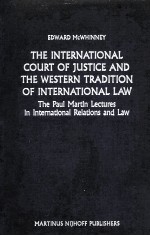
- 著
- 出版社: MARTINUS NIJHOFF PUBLISHERS
- ISBN:9024735246
- 出版时间:1987
- 标注页数:159页
- 文件大小:7MB
- 文件页数:173页
- 主题词:
PDF下载
下载说明
THE INTERNATIONAL COURT OF JUSTICE AND THE WESTERN TRADITION OF INTERNATIONAL LAWPDF格式电子书版下载
下载的文件为RAR压缩包。需要使用解压软件进行解压得到PDF格式图书。建议使用BT下载工具Free Download Manager进行下载,简称FDM(免费,没有广告,支持多平台)。本站资源全部打包为BT种子。所以需要使用专业的BT下载软件进行下载。如 BitComet qBittorrent uTorrent等BT下载工具。迅雷目前由于本站不是热门资源。不推荐使用!后期资源热门了。安装了迅雷也可以迅雷进行下载!
(文件页数 要大于 标注页数,上中下等多册电子书除外)
注意:本站所有压缩包均有解压码: 点击下载压缩包解压工具
图书目录
Chapter Ⅰ:The Challenge to 'Classical' International Law 1
(a) The objection of Eurocentrism 3
(i) Acquisition of territorial title by European 'discovery' 5
(b) The objection of Colonialism 8
(i) The special legal regime of Extraterritoriality in China 8
(ii) Economic imperialism in Latin America:the Calvo and Drago Doctrines 9
(iii) A duty of economic redress,and a New International Economic Order 11
(c) The Soviet Union,and 'new' or 'contemporary'International Law 12
(i) New imperative legal principles:Coexistence/Friendly Relations 12
(ii) 'New' International Law,and 'contemporary'International Law 15
(iii) Customary International Law newly up-graded 16
Chapter Ⅱ:Nature and Definition of International Law in an Era of Transition 20
(a) 'Classical' Sources,and new conceptions of Lawas-Fact and Law-as-Process 20
(i) Contemporaneity of the non-contemporaneous in International Law doctrine today:the 'old'and the 'new' textbooks 21
(ii) Complexities as to normativity in contemporary International Law-Making 25
(iii) Cross-currents and contradictions as to Sources and Processes in contemporary International Law-Making 28
(iv) Trend and directions in the definition of law today 31
(b) General Theory of Law:Legal Positivism,Legal Realism and Sociological Jurisprudence 32
(i) On the vocation of our times for a new General Theory of International Law 32
(ii) Disappearance of the single-author,comprehensive International Law texts 33
(iii) The positivist tradition of International Law and Legal Science 35
(iv) Legal Realism,and new Sociological approaches to International Law and Law-Making 40
(v) The Sociological and Policy-Science schools in conflict over International Law 47
Chapter Ⅲ:The Emerging Constitutionalism of World Order,and the International Court 55
(a) United Nations Charter:Treaty or Constitution? 55
(b) Democratic Constitutionalism:emergence of the U.N.General Assembly 58
(c) Reception of American constitutional ideas:the World Court and judicial Law-Making 65
(d) Evolution of the World Court:elections of judges 73
(i) 'Regional' trends in judicial elections 75
(ii) Some emerging voting patterns in judicial elections 80
(e) Western retreat from the Court 83
(i) Withdrawal from compulsory jurisdiction 83
(ii) Recourse to Arbitral tribunals 85
(iii) Special Chambers of the Court,and the issue of choice of judges 86
(f) Third World discovery of the Court 93
Chapter Ⅳ:Contemporary Crisis of the World Court:International Adjudication and International Legal Problem-Solving 99
(a) The Nicaragua v.United States of America processes,1984-1986 99
(b) Chronology of political-legal events in the Nicaragua processes,1984-1986 100
(c) The U.S.Government's objections to a World Court role in Nicaragua v.United States 102
(d) Nicaragua v.United States,Merits:the legal rationale 109
(i) Significance of the U.S.multilateral treaty eservation 110
(ii) The issue of 'justiciability',and the Law/Politics dichotomy 111
(iii) The non-appearance of the Respondent,United States 117
(iv) The claimed right of intervention by a Third Party,El Salvador 119
(v) The objection of 'interest' advanced against certain national judges 120
(e) U.N.Charter Law,and the applicability of general,Customary International Law 123
(f) The substantive-legal holdings of the Court's Merits ruling 127
(g) The innovative character of the Merits decision:Jus Cogens,Law-as-Fact,and 'Judge and Company' 129
(i) Non-use of Force and Non-intervention,as Jus Cogens 129
(ii) Law-as-Fact,and new approaches to 'Sources' of International Law 131
(iii) 'Judge and Company':the Court and other international law-making authorities 132
Chapter Ⅴ:The Future of International Adjudication and International Law 137
(a) Some myths and realities in current critiques of the Court 137
(i) The alleged anti-Western majority on the Court 137
(ii) The alleged 'Marxist-Leninist' behaviour of Soviet and Eastern European judges on the Court 138
(iii) The alleged 'ganging-up' by the Third World States in the election of judges 139
(b) The law/politics dichotomy,and the limits and possibilities of the judicial process 140
(c) 'Judge and Company':Court,General Assembly,Secretary-General,and Security Council 143
(d) Constitutional-legal linkage:relevance of Definition and General Theory of Law 144
(e) The problem of normativity:changing international law values in an era of transition 146
(f) 'Reception' of Western general legal ideas:the 'internationalisation' of the International Court and International Law 149
Index 155
精品推荐
- Northanger Abbey(1818)
- Emma(1815)
- Sense And Sensibility(1811)
- Mansfield Park(1814)
- HUMANITIES THE EVOLUTION OF VALUES
- Pride And Drejudice(1812)
- English
- 企鹅经济学词典 经济学
- 大人的友情 河合隼雄谈友谊
- Computing Concepts
- Advanced Compilpr Design and lmplementation
- 中国商事法律要览
- Introduction to polymers
- CONFICT OF LAWS IN THE WESTERN SOCIALIST AND DEVELOPING COUNTRIES
- Measurement and Research Methods in International Marketing