
图书介绍
COMPETIEION LAW AND PATENTSpdf电子书版本下载
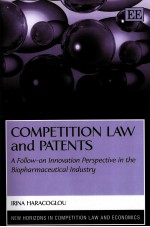
- IRINA HARACOGLOU 著
- 出版社: EDWARD ELGAR
- ISBN:1847205992
- 出版时间:2008
- 标注页数:251页
- 文件大小:12MB
- 文件页数:270页
- 主题词:
PDF下载
下载说明
COMPETIEION LAW AND PATENTSPDF格式电子书版下载
下载的文件为RAR压缩包。需要使用解压软件进行解压得到PDF格式图书。建议使用BT下载工具Free Download Manager进行下载,简称FDM(免费,没有广告,支持多平台)。本站资源全部打包为BT种子。所以需要使用专业的BT下载软件进行下载。如 BitComet qBittorrent uTorrent等BT下载工具。迅雷目前由于本站不是热门资源。不推荐使用!后期资源热门了。安装了迅雷也可以迅雷进行下载!
(文件页数 要大于 标注页数,上中下等多册电子书除外)
注意:本站所有压缩包均有解压码: 点击下载压缩包解压工具
图书目录
PART Ⅰ: THE PROBLEM - ACCESS AS A NECESSARY ELEMENT OF FOLLOW-ON INNOVATION?utical R&D: the increased importance of cumulative innovation and related concerns 3
1. Biopharmaceduction 3
1.1 Introase of research tools 7
1.2 The cfining research tools 7
1.2.1 Dee patent experience in biotechnology: biomedical research tools 9
1.2.2 The effect of patent trends on the patent balance for research tools 12
1.2.3 Thusion 16
1.3 ConclATENT BALANCE AND WORKING SOLUTIONS IN THE PATENT SYSTEMsystem as a system of balancing 21
PART Ⅱ: THE Patent Balance 21
2. The patent rticular importance of the patent balance in the biopharmaceutical industry 25
2.1 The Pe patent system and the biopharmaceutical industry 25
2.2 The particular importance of the patent balance in the biopharmaceutical industry 25
2.2.1 The patent system and the biopharmaceutical industry 25
2.2.1.1 Biopharmaceutical innovation and patenting 28
2.2.1.2 Has the importance of patents been overstated? 31
2.3 Conclusion 34
3. The patent system and some potential safety nets 36
3.1 Introduction to the patent safety nets 36
3.2 The patent safety nets 37
3.2.1 Experimental use exemption 39
3.2.1.1 The experimental use exemption: a viable and effective working solution? 39
3.2.1.2 The US experience: a helpful paradigm? 44
3.2.1.3 Conclusion on the EUE 46
3.2.2 The reverse doctrine of equivalents and blocking patents 48
3.2.3 Patent pools 51
3.2.4 Compulsory licensing in the patent provisions 54
3.2.4.1 Introduction to compulsory licensing 54
(a) Definition and history 54
(b) Support and opposition for CL 54
(c) Grounds for granting a compulsory licence 57
3.2.4.2 Analysis of the role of CL 58
(a) The role of CL in balancing commensurability 58
(i) CL as a mechanism to induce broad licensing 58
(ii) CL for non-use 59
(iii) CL for significant technological advances 59
(iv) CL to address health emergencies 61
(v) CL as a remedy for anti-competitive conduct 63
(b) Conclusions on CL 63
4. The right to health as an interpretive principle of patent law 70
4.1 Introduction 70
4.2 The right to health as a human right and its status in European law 71
4.2.1 Introduction to the right to health 71
4.2.2 Sources of the right to health 74
4.2.3 Implications of the right to health 76
4.2.3.1 Elements of the right to health 77
4.2.3.2 Obligation to respect, protect and fulfil 79
4.2.4 International Efforts to Strengthen the Right to Health 80
4.3 The right to health and patent law: The fundamental nature of health concerns and the move towards a right to health as an interpretive principle in patent law 82
4.3.1 The link between the right to health and patent law 82
4.3.1.1 The effect of patent law on the right to health 82
4.3.1.2 The effect of the right to health on patent law 83
4.3.2 The right to property and IP: IP as a human right 84
4.3.2.1 Striking the balance: limitations in the public interest 86
4.3.3 Patenting and the right to health 87
4.3.3.1 Direct effect 87
4.3.3.2 The indirect effect of the right to health 88
4.3.4 The right to health as an interpretive principle in patent law 90
4.3.4.1 Effect on specific patent provisions 91
4.3.4.2 Case-law on public health 93
4.3.4.3 European cases on IP and fundamental rights analysis 94
4.4 Conclusions 96
PART Ⅲ: ANTITRUST AS A COMPLEMENT TO THE PATENT SYSTEM 96
5. Unilateral conduct, intellectual property rights and Competition Law: a systems' interaction 101
5.1 Introduction 101
5.2 The practice of the courts 103
5.2.1 The existence/exercise distinction 103
5.3 IPRs and competition: A systems' interaction 107
5.3.1 IPRs - public goods, exclusivity and information goods 107
5.3.1.1 Public goods and market failure 107
5.3.1.2 Patronage, procurement and property 109
5.3.2 Implications for competition 112
5.3.2.1 IP like other property rights for the purposes of competition 112
5.3.2.2 Competition embedded in the IP system 114
5.3.2.3 The transition from separate to unified fields 114
5.3.2.4 How antitrust control affects incentives to innovate 116
5.3.3 Recent recognition of antitrust control 119
5.4 Conclusions 121
6. The Duty to Deal under Art. 82 EC 122
6.1 Introduction 122
6.1.1 What is a refusal to deal and what is the rationale behind its prohibition? 122
6.1.2 Concerns relating to a refusal to deal: Potential harm to competition 123
6.2 The state of the law 126
6.2.1 Cutting off existing customers: The dependence cases 128
6.2.2 'Reservation of an ancillary activity' and leverage economics 130
6.2.3 The indispensability requirement and the essential facilities doctrine (EFD) 133
6.2.3.1 Indispensability 135
6.2.3.2 Two-market requirement 138
6.2.3.3 Objective justification 139
6.2.4 New product innovation 141
6.3 Conclusions 143
Appendix The refusal to deal cases under Art. 82 145
PART Ⅳ: A MORE INNOVATION SENSITIVE APPROACH TO THE INTERFACE OF COMPETITION LAW AND PATENTS? 145
7. The duty to deal as applied to address technology access problems in the biopharmaceutical industry 177
7.1 Conclusions on the patent system in the case of research tools 177
7.1.1 The particularity of research tools: pre-commercial stage patents 177
7.1.2 A gap in the patent system? 179
7.1.3 The more the better? Optimal market structure for innovation 179
7.2 Two possible avenues for increased access to essential research tools 181
7.2.1 Patent law 181
7.2.2 A role for Art. 82? 185
7.2.2.1 Indispensability 186
7.2.2.2 Preventing the emergence of a new product for which there is potential consumer demand 187
7.2.2.3 Elimination of competition on a downstream or neighbouring market/two-market requirement 187
7.2.2.4 The absence of an objective justification 188
7.2.3.1 The impact of Art. 82 duty to deal with case-law on the patent system 189
7.2.3.2 An innovation sensitive approach:innovation markets in Art. 82? 191
7.2.3.3 Conclusions on compulsory licensing as a safety net 195
7.2.4 Conclusion: A human rights approach to competition law ? 196
Bibliography 200
Legislation and Guidelines 200
Reports and Studies 204
Authors 210
Index 239
精品推荐
- Northanger Abbey(1818)
- Emma(1815)
- Sense And Sensibility(1811)
- Mansfield Park(1814)
- HUMANITIES THE EVOLUTION OF VALUES
- Pride And Drejudice(1812)
- English
- 企鹅经济学词典 经济学
- 大人的友情 河合隼雄谈友谊
- Computing Concepts
- Advanced Compilpr Design and lmplementation
- 中国商事法律要览
- Introduction to polymers
- CONFICT OF LAWS IN THE WESTERN SOCIALIST AND DEVELOPING COUNTRIES
- Measurement and Research Methods in International Marketing