
图书介绍
THERMODYNAMICS AND AN INTRODUCTON TO THERMOSTATISTICS SECOND EDITIONpdf电子书版本下载
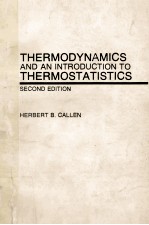
- HERBERT B.CALLEN 著
- 出版社: JOHN WILEY & SONS
- ISBN:0471862568
- 出版时间:1985
- 标注页数:494页
- 文件大小:236MB
- 文件页数:510页
- 主题词:
PDF下载
下载说明
THERMODYNAMICS AND AN INTRODUCTON TO THERMOSTATISTICS SECOND EDITIONPDF格式电子书版下载
下载的文件为RAR压缩包。需要使用解压软件进行解压得到PDF格式图书。建议使用BT下载工具Free Download Manager进行下载,简称FDM(免费,没有广告,支持多平台)。本站资源全部打包为BT种子。所以需要使用专业的BT下载软件进行下载。如 BitComet qBittorrent uTorrent等BT下载工具。迅雷目前由于本站不是热门资源。不推荐使用!后期资源热门了。安装了迅雷也可以迅雷进行下载!
(文件页数 要大于 标注页数,上中下等多册电子书除外)
注意:本站所有压缩包均有解压码: 点击下载压缩包解压工具
图书目录
PART Ⅰ GENERAL PRINCIPLES OF CLASSICAL THERMODYNAMICS 1
Introduction The Nature of Thermodynamics and the Basis of Thermostatistics 2
1 THE PROBLEM AND THE POSTULATES 5
1.1 The Temporal Nature of Macroscopic Measurements 5
1.2 The Spatial Nature of Macroscopic Measurements 6
1.3 The Composition of Thermodynamic Systems 9
1.4 The Internal Energy 11
1.5 Thermodynamic Equilibrium 13
1.6 Walls and Constraints 15
1.7 Measurability of the Energy 16
1.8 Quantitative Definition of Heat—Units 18
1.9 The Basic Problem of Thermodynamics 25
1.10 The Entropy Maximum Postulates 27
2 THE CONDITIONS OF EQUILIBRIUM 35
2.1 Intensive Parameters 35
2.2 Equations of State 37
2.3 Entropic Intensive Parameters 40
2.4 Thermal Equilibrium—Temperature 43
2.5 Agreement with Intuitive Concept of Temperature 45
2.6 Temperature Units 46
2.7 Mechanical Equilibrium 49
2.8 Equilibrium with Respect to Matter Flow 54
2.9 Chemical Equilibrium 56
3 SOME FORMAL RELATIONSHIPS,AND SAMPLE SYSTEMS 59
3.1 The Euler Equation 59
3.2 The Gibbs-Duhem Relation 60
3.3 Summary of Formal Structure 63
3.4 The Simple Ideal Gas and Multicomponent Simple Ideal Gases 66
3.5 The “Ideal van der Waals Fluid” 74
3.6 Electromagnetic Radiation 78
3.7 The “Rubber Band” 80
3.8 Unconstrainable Variables; Magnetic Systems 81
3.9 Molar Heat Capacity and Other Derivatives 84
4 REVERSIBLE PROCESSES AND THE MAXIMUM WORK THEOREM 91
4.1 Possible and Impossible Processes 91
4.2 Quasi-Static and Reversible Processes 95
4.3 Relaxation Times and Irreversibility 99
4.4 Heat Flow:Coupled Systems and Reversal of Processes 101
4.5 The Maximum Work Theorem 103
4.6 Coefficients of Engine,Refrigerator,and Heat Pump Performance 113
4.7 The Carnot Cycle 118
4.8 Measurability of the Temperature and of the Entropy 123
4.9 Other Criteria of Engine Performance; Power Output and“Endoreversible Engines” 125
4.10 Other Cyclic Processes 128
5 ALTERNATIVE FORMULATIONS AND LEGENDRE TRANSFORMATIONS 131
5.1 The Energy Minimum Principle 131
5.2 Legendre Transformations 137
5.3 Thermodynamic Potentials 146
5.4 Generalized Massieu Functions 151
6 THE EXTREMUM PRINCIPLE IN THE LEGENDRE TRANSFORMED REPRESENTATIONS 153
6.1 The Minimum Principles for the Potentials 153
6.2 The Helmholtz Potential 157
6.3 The Enthalpy; The Joule-Thomson or “Throttling” Process 160
6.4 The Gibbs Potential; Chemical Reactions 167
6.5 Other Potentials 172
6.6 Compilations of Empirical Data; The Enthalpy of Formation 173
6.7 The Maximum Principles for the Massieu Functions 179
7 MAXWELL RELATIONS 181
7.1 The Maxwell Relations 181
7.2 A Thermodynamic Mnemonic Diagram 183
7.3 A Procedure for the Reduction of Derivatives in Single-Component Systems 186
7.4 Some Simple Applications 190
7.5 Generalizations:Magnetic Systems 199
8 STABILITY OF THERMODYNAMIC SYSTEMS 203
8.1 Intrinsic Stability of Thermodynamic Systems 203
8.2 Stability Conditions for Thermodynamics Potentials 207
8.3 Physical Consequences of Stability 209
8.4 Le Chatelier’s Principle; The Qualitative Effect of Fluctuations 210
8.5 The Le Chatelier-Braun Principle 212
9 FIRST-ORDER PHASE TRANSITIONS 215
9.1 First-Order Phase Transitions in Single-Component Systems 215
9.2 The Discontinuity in the Entropy-Latent Heat 222
9.3 The Slope of Coexistence Curves; the Clapeyron Equation 228
9.4 Unstable Isotherms and First-Order Phase Transitions 233
9.5 General Attributes of First-Order Phase Transitions 243
9.6 First-Order Phase Transitions in Multicomponent Systems—Gibbs Phase Rule 245
9.7 Phase Diagrams for Binary Systems 248
10 CRITICAL PHENOMENA 255
10.1 Thermodynamics in the Neighborhood of the Critical Point 255
10.2 Divergence and Stability 261
10.3 Order Parameters and Critical Exponents 263
10.4 Classical Theory in the Critical Region; Landau Theory 265
10.5 Roots of the Critical Point Problem 270
10.6 Scaling and Universality 272
11 THE NERNST POSTULATE 277
11.1 Nernst’s Postulate,and the Principle of Thomsen and Bertholot 277
11.2 Heat Capacities and Other Derivatives at Low Temperatures 280
11.3 The “Unattainability” of Zero Temperature 281
12 SUMMARY OF PRINCIPLES FOR GENERAL SYSTEMS 283
12.1 General Systems 283
12.2 The Postulates 283
12.3 The Intensive Parameters 284
12.4 Legendre Transforms 285
12.5 Maxwell Relations 285
12.6 Stability and Phase Transitions 286
12.7 Critical Phenomena 287
12.8 Properties at Zero Temperature 287
13 PROPERTIES OF MATERIALS 289
13.1 The General Ideal Gas 289
13.2 Chemical Reactions in Ideal Gases 292
13.3 Small Deviations from “Ideality”—The Virial Expansion 297
13.4 The “Law of Corresponding States” for Gases 299
13.5 Dilute Solutions:Osmotic Pressure and Vapor Pressure 302
13.6 Solid Systems 305
14 IRREVERSIBLE THERMODYNAMICS 307
14.1 General Remarks 307
14.2 Affinities and Fluxes 308
14.3 Purely-Resistive and Linear Systems 312
14.4 The Theoretical Basis of the Onsager Reciprocity 314
14.5 Thermoelectric Effects 316
14.6 The Conductivities 319
14.7 The Seebeck Effect and the Thermoelectric Power 320
14.8 The Peltier Effect 323
14.9 The Thomsen Effect 324
ART Ⅱ TATISTICAL MECHANICS 329
15 STATISTICAL MECHANICS IN THE ENTROPY REPRESENTATION:THE MICROCANONICAL FORMALISM 329
15.1 Physical Significance of the Entropy for Closed Systems 329
15.2 The Einstein Model of a Crystalline Solid 333
15.3 The Two-State System 337
15.4 A Polymer Model—The Rubber Band Revisited 339
15.5 Counting Techniques and their Circumvention;High Dimensionality 343
16 THE CANONICAL FORMALISM; STATISTICAL MECHANICS IN HELMHOLTZ REPRESENTATION 349
16.1 The Probability Distribution 349
16.2 Additive Energies and Factorizability of the Partition Sum 353
16.3 Internal Modes in a Gas 355
16.4 Probabilities in Factorizable Systems 358
16.5 Statistical Mechanics of Small Systems:Ensembles 360
16.6 Density of States and Density-of-Orbital States 362
16.7 The Debye Model of Non-metallic Crystals 364
16.8 Electromagnetic Radiation 368
16.9 The Classical Density of States 370
16.10 The Classical Ideal Gas 372
16.11 High Temperature Properties—The Equipartition Theorem 375
17 ENTROPY AND DISORDER; GENERALIZED CANONICAL FORMULATIONS 379
17.1 Entropy as a Measure of Disorder 379
17.2 Distributions of Maximal Disorder 382
17.3 The Grand Canonical Formalism 385
18 QUANTUM FLUIDS 393
18.1 Quantum Particles; A “Fermion Pre-Gas Model” 393
18.2 The Ideal Fermi Fluid 399
18.3 The Classical Limit and the Quantum Criteria 402
18.4 The Strong Quantum Regime; Electrons in a Metal 405
18.5 The Ideal Bose Fluid 410
18.6 Non-Conserved Ideal Bose Fluids; Electromagnetic Radiation Revisited 412
18.7 Bose Condensation 413
19 FLUCTUATIONS 423
19.1 The Probability Distribution of Fluctuations 423
19.2 Moments and The Energy Fluctuations 424
19.3 General Moments and Correlation Moments 426
20 VARIATIONAL PROPERTIES,PERTURBATION EXPANSIONS,AND MEAN FIELD THEORY 433
20.1 The Bogoliubov Variational Theorem 433
20.2 Mean Field Theory 440
20.3 Mean Field Theory in Generalized Representation;the Binary Alloy 449
PART Ⅲ FOUNDATIONS 455
21 POSTLUDE:SYMMETRY AND THE CONCEPTUAL FOUNDATIONS OF THERMOSTATISTICS 455
21.1 Statistics 455
21.2 Symmetry 458
21.3 Noether’s Theorem 460
21.4 Energy,Momentum and Angular Momentum; the Generalized “First Law” of Thermodynamics 461
21.5 Broken Symmetry and Goldstone’s Theorem 462
21.6 Other Broken Symmetry Coordinates—Electric and Magnetic Moments 465
21.7 Mole Numbers and Gauge Symmetry 466
21.8 Time Reversal,the Equal Probability of Microstates,and the Entropy Principle 467
21.9 Symmetry and Completeness 469
APPENDIX A SOME RELATIONS INVOLVING PARTIAL DERIVATIVES 473
A.1 Partial Derivatives 473
A.2 Taylor’s Expansion 474
A.3 Differentials 475
A.4 Composite Functions 475
A.5 Implicit Functions 476
APPENDIX B MAGNETIC SYSTEMS 479
GENERAL REFERENCES 485
INDEX 487
精品推荐
- Northanger Abbey(1818)
- Emma(1815)
- Sense And Sensibility(1811)
- Mansfield Park(1814)
- HUMANITIES THE EVOLUTION OF VALUES
- Pride And Drejudice(1812)
- English
- 企鹅经济学词典 经济学
- 大人的友情 河合隼雄谈友谊
- Computing Concepts
- Advanced Compilpr Design and lmplementation
- 中国商事法律要览
- Introduction to polymers
- CONFICT OF LAWS IN THE WESTERN SOCIALIST AND DEVELOPING COUNTRIES
- Measurement and Research Methods in International Marketing