
图书介绍
语言的主观性 对英语IF条件句构式多义性的认知研究pdf电子书版本下载
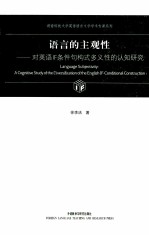
- 徐李洁著 著
- 出版社: 北京:外语教学与研究出版社
- ISBN:9787560076324
- 出版时间:2008
- 标注页数:149页
- 文件大小:5MB
- 文件页数:165页
- 主题词:英语-句法-研究
PDF下载
下载说明
语言的主观性 对英语IF条件句构式多义性的认知研究PDF格式电子书版下载
下载的文件为RAR压缩包。需要使用解压软件进行解压得到PDF格式图书。建议使用BT下载工具Free Download Manager进行下载,简称FDM(免费,没有广告,支持多平台)。本站资源全部打包为BT种子。所以需要使用专业的BT下载软件进行下载。如 BitComet qBittorrent uTorrent等BT下载工具。迅雷目前由于本站不是热门资源。不推荐使用!后期资源热门了。安装了迅雷也可以迅雷进行下载!
(文件页数 要大于 标注页数,上中下等多册电子书除外)
注意:本站所有压缩包均有解压码: 点击下载压缩包解压工具
图书目录
Chapter 1 Introduction 1
1.1 Diversified Interpretations of the English If-Conditional Construction 2
1.2 Conditionals and If-Conditionals 5
1.3 Research Questions 7
1.4 Methodology and Procedures 8
1.5 Structure of the Book 9
Chapter 2 The Historical Background 11
2.1 Major Approaches to the If-Conditional Construction 12
2.1.1 Logic-semantic Approach 12
2.1.2 Functional-pragmatic Approach 15
2.1.3 Cognitive Approach 18
2.1.4 Brief Evaluation:Approaches and Problems 20
2.2 Typological Classifications of the If-Conditional Construction 22
2.2.1 Formal Term 22
2.2.2 Semantic Term 23
2.2.3 Epistemic Term 25
2.2.4 Sweetser's Three-domain Theory 27
2.3 Summary 30
Chapter 3 Theoretical Prerequisites 31
3.1 Recent Studies on Subjectivity and Subjectivisation 31
3.1.1 Traugott's View of Subjectivisation 35
3.1.2 Langacker's View of Subjectivisation 41
3.2 Establishment of the Model for the Analysis of Subjectivisation of If-Conditional Construction 44
3.2.1 Subjectivity 44
3.2.2 Rationale of the Model 45
3.2.2.1 Cognitive Foundation 45
3.2.2.2 Psychological Foundation 49
3.2.2.3 Linguistic Foundation 51
3.2.3 The Model 52
3.2.4 The Process of Subjectivisation 53
3.2.5 The Significance of the Model 59
3.3 Summary 60
Chapter 4 The Prototypical If-Conditional Construction 61
4.1 Conditions in Logic 61
4.2 Conditions and If-Conditional Construction 65
4.3 Transmutations of Conditions 69
4.4 The Prototypical If-Conditional Construction 72
4.4.1 Semantic Feature—Causal Relation 73
4.4.2 Syntactic Feature 77
4.4.2.1 Verb Form 78
4.4.2.2 Clause Order 81
4.4.3 Pragmatic Feature 84
4.4.3.1 Non-assertiveness of the Antecedent 85
4.4.3.2 The Determinant Role of Pragmatic Contexts 86
4.5 Summary 88
Chapter 5 Subjectivisation in Epistemic If-Conditional Construction 90
5.1 Epistemic Raising 90
5.2 Semantic Relations in Epistemic If-Conditionals 93
5.2.1 Premise-conclusion Relation 93
5.2.2 Statement-comment Relation 96
5.2.3 Statement-explanation Relation 99
5.3 Syntactic Feature 102
5.3.1 Verb Form 102
5.3.2 Clause Order 104
5.4 Pragmatic Feature 105
5.4.1 Antecedent as a Topic Marker 105
5.4.2 Antecedents as Discourse-bounded 107
5.5 Summaryv 110
Chapter 6 Subjectivisation in Speech-Act If-Conditional Construction 111
6.1 Common Features with Epistemic If-Conditionals 111
6.1.1 Indirect and Implicit Conditional Relation 112
6.1.2 Verb Form 114
6.1.3 Clause Order 116
6.1.4 Antecedent as a Topic Marker 117
6.2 Pragmatic Feature Peculiar to Speech-Act If-Conditionals 119
6.2.1 Felicity Conditions and Speech-Act Conditionals 119
6.2.1.1 A Briering ofFelicity Condition 119
6.2.1.2 Felicity Conditions Encoded in the Antecedent 120
6.2.2 Politeness and Speech-Act Conditionals 123
6.2.2.1 Formulaic Polite Expressions 123
6.2.2.2 Strategic Polite Expressions 127
6.3 Subjectivity Indicated in the Speaker's Commitment to the Antecedent 129
6.4 Summary 132
Chapter 7 Summary and Conclusions 134
7.1 Major Findings 134
7.2 Theoretical Implications 137
7.3 Further Research 138
References 141