
图书介绍
儿童语言发展引论pdf电子书版本下载
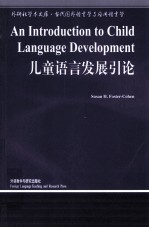
- (英)福斯特科恩(Foster-Cohen S.H.)著;李行德导读 著
- 出版社: 北京:外语教学与研究出版社
- ISBN:7560085296
- 出版时间:2012
- 标注页数:241页
- 文件大小:12MB
- 文件页数:278页
- 主题词:
PDF下载
下载说明
儿童语言发展引论PDF格式电子书版下载
下载的文件为RAR压缩包。需要使用解压软件进行解压得到PDF格式图书。建议使用BT下载工具Free Download Manager进行下载,简称FDM(免费,没有广告,支持多平台)。本站资源全部打包为BT种子。所以需要使用专业的BT下载软件进行下载。如 BitComet qBittorrent uTorrent等BT下载工具。迅雷目前由于本站不是热门资源。不推荐使用!后期资源热门了。安装了迅雷也可以迅雷进行下载!
(文件页数 要大于 标注页数,上中下等多册电子书除外)
注意:本站所有压缩包均有解压码: 点击下载压缩包解压工具
图书目录
1 What do children bring to the languageacquisition task? 1
Chapter summary 1
Introduction 1
Two different approaches 4
Competence versus performance 9
Some recurring questions 10
Some premises 11
Questions for discussion 13
An activity 13
Further reading 14
2 How do children communicate beforethey can use language? 16
Chapter summary 16
Clues for understanding 16
Facial expressions 17
Cries, coos and grunts 19
Infant speech perception 20
Babbling 22
The transition to language 24
First words 26
Gestures 27
Language and gesture 28
Discussion of in-text exercises 30
Questions for discussion 31
Some activities 31
Solutions to and comments on discussion questions and activities 32
Further reading 34
3 When does language development start? 35
Chapter summary 35
What's in a word? 35
Meaning through word and context 39
Early vocabulary 42
Semantic descriptions of early utterances 44
Arguments for a richer account of early utterances 46
To be or not to be a language 52
Discussion of in-text exercises 53
Questions for discussion 57
Some activities 57
Solution to and comments on discussion questions and activities 60
Further reading 61
4 How do young children think language works? 62
Chapter summary 62
Looking at children's language 62
Analysing children's language 67
Discussion of in-text exercises 87
Questions for discussion 89
Some activities 89
Solutions to and comments on discussion questions and activities 92
Further reading 93
5 What influences language development? 95
Chapter summary 95
What is input and how much is enough? 95
Input at the right time: the ‘critical period’ 96
Is active communication necessary? 97
The nature of Baby Talk 98
The value of Baby Talk 100
Universal Grammar 107
Words are more cunning than they let on 110
Discussion of in-text exercises 114
Questions for discussion 114
An activity 115
Solutions to and comments on discussion questions and activity 116
Further reading 117
6 Do all children learn language the same way? 119
Chapter summary 119
Types of variation 119
Different endpoints 120
Differences in path of development 129
Differences in rate of development 138
Discussion of in-text exercises 140
Questions for discussion 140
Some activities 141
Solutions to and comments on discussion questions 142
Further reading 143
7 Does it matter which language(s) you learn? 144
Chapter summary 144
Introduction 144
So what's so very different, anyway? 145
A parameter theory of language acquisition 148
How do children become bilingual? 154
Discussion of in-text exercises 164
Questions for discussion 165
Some activities 165
Solutions to and comments on discussion questions and activities 167
Further reading 169
8 When does language development stop? 171
Chapter summary 171
Later oral language development 171
Pragmatic aspects of later language development 176
Basic steps in learning to read 179
Basic steps in learning to write 181
Metalinguistic development 183
Discussion of in-text exercises 196
Questions for discussion 198
Some activities 199
Solutions to and comments on discussionquestions and activities 201
Further reading 202
Appendix 1 Tools for studying children'slanguage 203
Transcription 203
Mean Length of Utterance calculations 205
T-unit calculations 206
Some dos and don'ts of research design 207
Finding data 208
Bulletin boards 209
Journals in child language 209
Associations 210
Conferences 210
Further reading 210
Appendix 2 Phonetic symbols 211
Consonants 212
Vowels 213
Other symbols 213
Bibliography 214
Index 229
文库索引 233