
图书介绍
翻译的文本分析模式 第2版pdf电子书版本下载
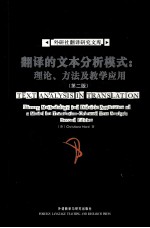
- (德)诺德(Nord,C.)著 著
- 出版社: 北京:外语教学与研究出版社
- ISBN:7560059503
- 出版时间:2006
- 标注页数:274页
- 文件大小:14MB
- 文件页数:292页
- 主题词:翻译理论-研究-英文
PDF下载
下载说明
翻译的文本分析模式 第2版PDF格式电子书版下载
下载的文件为RAR压缩包。需要使用解压软件进行解压得到PDF格式图书。建议使用BT下载工具Free Download Manager进行下载,简称FDM(免费,没有广告,支持多平台)。本站资源全部打包为BT种子。所以需要使用专业的BT下载软件进行下载。如 BitComet qBittorrent uTorrent等BT下载工具。迅雷目前由于本站不是热门资源。不推荐使用!后期资源热门了。安装了迅雷也可以迅雷进行下载!
(文件页数 要大于 标注页数,上中下等多册电子书除外)
注意:本站所有压缩包均有解压码: 点击下载压缩包解压工具
图书目录
Ⅰ.INTRODUCTION:The need for text analysis in translation 1
Ⅱ.A MODEL FOR TRANSLATION-ORIENTED TEXT ANALYSIS 5
1.Theoretical principles 5
1.1.Translatological foundations 5
1.1.1.Factors and constituents of the translation process 5
1.1.2.The role of the initiator 9
1.1.3.The role of the translator 11
1.2.Text-linguistic foundations 13
1.2.1.The text as a communicative interaction 13
1.2.2.The process of text reception 17
1.2.3.Text typologies 19
2.The role and function of source-text analysis 25
2.1.Possible relationships between source text and target text 25
2.1.1.Fidelity-liberty-equivalence 25
2.1.2.Skopos and intertextual coherence 27
2.1.3.Intercultural cooperation 30
2.1.4.Functionality plus loyalty 31
2.2.Phases of the translation process 34
2.2.1.The two-phase model 34
2.2.2.The three-phase model 35
2.2.3.The looping model 36
3.The factors of source-text analysis 41
3.0.General considerations 41
3.1.Extratextual factors 43
3.1.0.Basic notions 43
3.1.1.Sender 47
3.1.2.Sender's intention 53
3.1.3.Audience 57
3.1.4.Medium 62
3.1.5.Place of communication 67
3.1.6.Time of communication 70
3.1.7.Motive for communication 74
3.1.8.Text function 77
3.1.9.The interdependence of extratextual factors 83
3.2.Intratextual factors 87
3.2.0.Basic notions 87
3.2.1.Subject matter 93
3.2.2.Content 98
3.2.3.Presuppositions 105
3.2.4.Text composition 110
3.2.5.Non-verbal elements 118
3.2.6.Lexis 122
3.2.7.Sentence structtre 129
3.2.8.Suprasegmental features 131
3.2.9.The interdependence of intratextual factors 139
3.3.Effect 143
4.Applications of the model in translator training 155
4.0.General considerations 155
4.1.Planning the process of translation training 161
4.1.0.Fundamentals 161
4.1.1.Selecting texts for translation classes 162
4.1.2.Grading the difficulty of translation tasks 165
4.1.3.Grading the difficulty of translation texts 172
4.2.Classifying translation problems 174
4.3.Testing transfer competence 177
4.4.Assessing translation quality 179
4.4.0.Forms and functions of translation criticism 179
4.4.1.Translation criticism vs.translation comparison 181
4.4.2.A didactic model of translation criticism 182
4.4.3.Defining translation errors 186
4.4.4.Evaluating translation tasks 188
5.Sample texts 191
5.0.General considerations 191
5.1.Text 1:The relationship between intention and function-Alejo Carpentier:Acerca de la historicidad de Victor Hugues 192
5.1.0.Text 192
5.1.1.Analysis of extratextual factors 193
5.1.2.The postscript Acerca de la historicidad de Vícto Hugues 194
5.1.3.The reflection of the extratextual factors in the text 195
5.1.4.Analysis of intratextual factors 197
5.1.5.Analysis of effect 200
5.1.6.Translation criticism 201
5.1.7.Conclusions and suggested translations 217
5.2.Text 2:The relationship between subject matter,text structure and effect-Miguel de Unamuno:Niebla 223
5.2.0.Text 223
5.2.1.Analysis of extratextual factors 223
5.2.2.The beginning of a text as a key to its interpretation 224
5.2.3.Some considerations on ironic intention 225
5.2.4.Analysis of text structure 227
5.2.5.Translation criticism 234
5.2.6.Conclusions and suggested translations 240
5.3.Text 3:The relationship between text function and audience orientation-Tourist information:SPEZIALIT?TEN 243
5.3.0.Text 243
5.3.1.Analysis of extratextual factors 243
5.3.2.The relevance of audience orientation 244
5.3.3.Analysis of intratextual factors 244
5.3.4.Translation criticism 250
5.3.5.Conclusions 256
Ⅲ.FINAL CONSIDERATIONS 257
Ⅳ.INDEX OF TRANSLATION PROBLEMS 263
Ⅴ.INDEX OF EXAMPLES 264
Ⅵ.REFERENCES 265