
图书介绍
从人体上肢到康复机器人 人体上肢运动机理研究导论 英文版pdf电子书版本下载
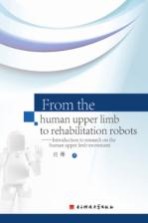
- 刘珊著 著
- 出版社: 成都:电子科技大学出版社
- ISBN:7564704780
- 出版时间:2010
- 标注页数:127页
- 文件大小:7MB
- 文件页数:137页
- 主题词:机器人-应用-康复训练-英文
PDF下载
下载说明
从人体上肢到康复机器人 人体上肢运动机理研究导论 英文版PDF格式电子书版下载
下载的文件为RAR压缩包。需要使用解压软件进行解压得到PDF格式图书。建议使用BT下载工具Free Download Manager进行下载,简称FDM(免费,没有广告,支持多平台)。本站资源全部打包为BT种子。所以需要使用专业的BT下载软件进行下载。如 BitComet qBittorrent uTorrent等BT下载工具。迅雷目前由于本站不是热门资源。不推荐使用!后期资源热门了。安装了迅雷也可以迅雷进行下载!
(文件页数 要大于 标注页数,上中下等多册电子书除外)
注意:本站所有压缩包均有解压码: 点击下载压缩包解压工具
图书目录
Chapter 1 Introduction 1
1.1 The Motivation 1
1.2 The main problem and the main thesis 2
1.3 Organization of the book 4
Chapter 2 Human motor control 6
2.1 Introduction 6
2.2 The biological system 7
2.1.1 The central nervous system 7
2.2.2 Proprioceptors and the spinal cord 8
2.2.3 Motor neurons,and motor units 9
2.2.4 The muscle and the joints 10
2.2.5 Limitations of the technical description 10
2.3 Neuromotor control strategies 11
2.3.1 Feedback control 11
2.3.2 Feed-forward control 12
2.3.3 Adaptive control 13
2.3.4 Motor planning 14
2.3.5 Optimal control 15
2.3.6 Internal models 17
2.3.7 Artificial neural network control 18
2.4 Redundancy,degeneracy and parallelism 20
2.4.1 Multiple feedback loops 21
2.4.2 Spatial filtering 22
2.4.3 Learning to exploit the redundancy 23
2.5 Mathematical modeling 24
2.5.1 Theoretical muscle modeling 25
2.5.2 Modeling assumptions 25
2.5.3 Muscle contraction 26
2.5.4 Musculoskeletal system 27
2.5.5 Muscle model 28
2.5.6 Arm model 29
Chapter 3 Studying motor control 31
3.1 The inverse control problem 31
3.2 Forward model 33
3.3 Inverse model 35
3.4 Trajectory planning 35
3.5 Optimal control 36
3.6 Adaptive control 38
3.7 Hierarchical control 39
3.8 Neural network control 40
3.9 Reinforcement learning 42
3.10 Impedance control 43
3.11 End-effector control 45
Chapter 4 Motor learning and rehabilitation robot 47
4.1 Human-robot interaction 47
4.2 Motor learning 48
4.3 Current view of rehabilitation robot 49
4.4 Problem in current view 51
Chapter 5 Posture control of the upper limb 54
5.1 Posture control 54
5.2 Artificial neural network control 57
5.3 Multilayer perceptron network controller 59
5.3.1 Structure 59
5.3.2 Training algorithm 60
5.3.3 Simulation results 61
5.3.4 Discussion 63
5.4 Multivariable sliding-mode-based fuzzy CMAC 64
5.4.1 Problem formulation 64
5.4.2 Sliding-mode-based fuzzy CMAC 65
5.4.3 Training algorithm 66
5.4.4 Stability analysis 68
5.4.5 Simulation results 70
Chapter 6 Trajectory tracking control of the upper limb 72
6.1 Trajectory tracking control 72
6.2 Evolutionary diagonal recurrent neural network 73
6.2.1 Overview 73
6.2.2 Muscle model 74
6.2.3 Control system structure 74
6.2.4 Structure of the DRNN 75
6.2.5 Optimization of the DRNN Structure 75
6.2.6 DRNN Weight Training 78
6.2.7 Simulation Results 79
6.2.8 Discussion 85
6.3 Sliding-mode-based diagonal recurrent CMAC 85
6.3.1 Overview 85
6.3.2 Problem formulation 86
6.3.3 Sliding mode controller 86
6.3.4 SDRCMAC Architecture 87
6.3.5 Training algorithm 89
6.3.6 Stability analysis 91
6.3.7 Implementations and results 93
Chapter 7 Human-robot control system 96
7.1 Overview 96
7.2 Human-robot system 97
7.2.1 Structure 97
7.2.2 Function of patients'voluntary torque 97
7.2.3 Dynamic model 98
7.2.4 Control requirement 98
7.3 Sliding mode controller 99
7.3.1 Problem formulation 99
7.3.2 Controller design 100
7.3.3 Stability of the Control System 101
7.3.4 Simulation results 101
7.3.5 Summary and discussion 104
7.4 Robust control system 105
7.4.1 Controller architecture 105
7.4.2 Robust controller 105
7.4.3 Simulation results 106
7.4.4 Experimental results 108
7.4.5 Summary and discussion 114
7.5 SDRCMAC 115
Reference 117