
图书介绍
英语学习者口语交际能力研究 语料库语言学视角pdf电子书版本下载
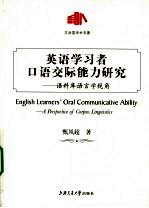
- 甄凤超编著 著
- 出版社: 上海:上海交通大学出版社
- ISBN:9787313055750
- 出版时间:2009
- 标注页数:270页
- 文件大小:13MB
- 文件页数:287页
- 主题词:英语-口语-研究
PDF下载
下载说明
英语学习者口语交际能力研究 语料库语言学视角PDF格式电子书版下载
下载的文件为RAR压缩包。需要使用解压软件进行解压得到PDF格式图书。建议使用BT下载工具Free Download Manager进行下载,简称FDM(免费,没有广告,支持多平台)。本站资源全部打包为BT种子。所以需要使用专业的BT下载软件进行下载。如 BitComet qBittorrent uTorrent等BT下载工具。迅雷目前由于本站不是热门资源。不推荐使用!后期资源热门了。安装了迅雷也可以迅雷进行下载!
(文件页数 要大于 标注页数,上中下等多册电子书除外)
注意:本站所有压缩包均有解压码: 点击下载压缩包解压工具
图书目录
Chapter 1 Introduction 1
1.1 Motivations for the book 1
1 2 Research objectives 6
1.3 Outline of the book 8
Chapter 2 CriticaI Discussion of the Previous Studies on Learner Language 10
2.1 Changes in current linguistic and SLA research 10
2.2 Main features of CLC data 14
2.3 Methodological approaches to CLC research 17
2.4 Studies based on learner corpora 23
2.5 Conversation analysis 31
2.6 Communicative competence 36
2.7 Conclusion 43
Chapter 3 Defining Oral Communicative Ability 45
3.1 Features of oral communication 45
3.2 Accuracy,fluency and appropriacy 48
3.3 Four essential components 53
3.4 Conclusion 90
Chapter 4 Research Methodology 92
4.1 The COLSEC 92
4.2 The data in the book 98
4.3 Methods for data extraction and processing 102
4.4 Summary 109
Chapter 5 Findings and Analysis(1):Productive Vocabulary Size and the Ability to Use PCs 111
5.1 Productive vocabulary size 111
5.2 The abilitv to use PCs 120
5 3 Summary 177
Chapter 6 Findings and Analysis(2):the Ability to Manipulate Schemata 180
6.1 Introduction 180
6 2 Key words for the Use of Computers 181
6.3 Key words for Going on Tour 190
6.4 Discussion and conclusion 192
Chapter 7 Findings and Analysis(3):Pragmatic Competence and Strategic Competence 195
7.1 Pragmatic markers 195
7.2 Interruptions and overlaps 203
7.3 Strategies for taking,holding and yielding turns 215
7.4 Reactive tokens 224
7.5 Summary 228
Chapter 8 Conclusion 230
8.1 Summary of findings 230
8.2 Implications for pedagogy 235
8.3 Limitations ofthe book 239
8.4 Directions for further researches 240
Appendices 242
Appendix A An error classification system 242
Appendix B Error types in three groups 246
Appendix C Collocates of IMPROVE in the position of n in the pattern V n from the SBNC 249
Appendix D Collocates of KNOWLEDGE in the pattern v N from the SBNC 253
References 256