
图书介绍
矩阵群 李群理论基础 英文pdf电子书版本下载
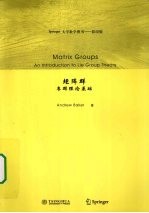
- AndrewBaker编著 著
- 出版社: 北京:清华大学出版社
- ISBN:9787302214847
- 出版时间:2009
- 标注页数:330页
- 文件大小:8MB
- 文件页数:346页
- 主题词:李群-高等学校-教材-英文
PDF下载
下载说明
矩阵群 李群理论基础 英文PDF格式电子书版下载
下载的文件为RAR压缩包。需要使用解压软件进行解压得到PDF格式图书。建议使用BT下载工具Free Download Manager进行下载,简称FDM(免费,没有广告,支持多平台)。本站资源全部打包为BT种子。所以需要使用专业的BT下载软件进行下载。如 BitComet qBittorrent uTorrent等BT下载工具。迅雷目前由于本站不是热门资源。不推荐使用!后期资源热门了。安装了迅雷也可以迅雷进行下载!
(文件页数 要大于 标注页数,上中下等多册电子书除外)
注意:本站所有压缩包均有解压码: 点击下载压缩包解压工具
图书目录
Part Ⅰ.Basic Ideas and Examples 3
1.Real and Complex Matrix Groups 3
1.1 Groups of Matrices 3
1.2 Groups of Matrices as Metric Spaces 5
1.3 Compactness 12
1.4 Matrix Groups 15
1.5 Some Important Examples 18
1.6 Complex Matrices as Real Matrices 29
1.7 Continuous Homomorphisms of Matrix Groups 31
1.8 Matrix Groups for Normed Vector Spaces 33
1.9 Continuous Group Actions 37
2.Exponentials, Differential Equations and One-parameter Sub-groups 45
2.1 The Matrix Exponential and Logarithm 45
2.2 Calculating Exponentials and Jordan Form 51
2.3 Differential Equations in Matrices 55
2.4 One-parameter Subgroups in Matrix Groups 56
2.5 One-parameter Subgroups and Differential Equations 59
3.Tangent Spaces and Lie Algebras 67
3.1 Lie Algebras 67
3.2 Curves,Tangent Spaces and Lie Algebras 71
3.3 The Lie Algebras of Some Matrix Groups 76
3.4 Some Observations on the Exponential Function of a Matrix Group 84
3.5 SO(3) and SU(2) 86
3.6 The Complexification of a Real Lie Algebra 92
4.Algebras,Quaternions and Quaternionic Symplectic Groups 99
4.1 Algebras 99
4.2 Real and Complex Normed Algebras 111
4.3 Linear Algebra over a Division Algebra 113
4.4 The Quaternions 116
4.5 Quaternionic Matrix Groups 120
4.6 Automorphism Groups of Algebras 122
5.Clifford Algebras and Spinor Groups 129
5.1 Real Clifford Algebras 130
5.2 Clifford Groups 139
5.3 Pinor and Spinor Groups 143
5.4 The Centres of Spinor Groups 151
5.5 Finite Subgroups of Spinor Groups 152
6.Lorentz Groups 157
6.1 Lorentz Groups 157
6.2 A Principal Axis Theorem for Lorentz Groups 165
6.3 SL2(C) and the Lorentz Group Lor(3,1) 171
Part Ⅱ.Matrix Groups as Lie Groups 181
7.Lie Groups 181
7.1 Smooth Manifolds 181
7.2 Tangent Spaces and Derivatives 183
7.3 Lie Groups 187
7.4 Some Examples of Lie Groups 189
7.5 Some Useful Formulae in Matrix Groups 193
7.6 Matrix Groups are Lie Groups 199
7.7 Not All Lie Groups are Matrix Groups 203
8.Homogeneous Spaces 211
8.1 Homogeneous Spaces as Manifolds 211
8.2 Homogeneous Spaces as Orbits 215
8.3 Projective Spaces 217
8.4 Grassmannians 222
8.5 The Gram-Schmidt Process 224
8.6 Reduced Echelon Form 226
8.7 Real Inner Products 227
8.8 Symplectic Forms 229
9.Connectivity of Matrix Groups 235
9.1 Connectivity of Manifolds 235
9.2 Examples of Path Connected Matrix Groups 238
9.3 The Path Components of a Lie Group 241
9.4 Another Connectivity Result 244
Part Ⅲ.Compact Connected Lie Groups and their Classification 244
10.Maximal Tori in Compact Connected Lie Groups 251
10.1 Tori 251
10.2 Maximal Tori in Compact Lie Groups 255
10.3 The Normaliser and Weyl Group of a Maximal Torus 259
10.4 The Centre of a Compact Connected Lie Group 263
11.Semi-simple Factorisation 267
11.1 An Invariant Inner Product 267
11.2 The Centre and its Lie Algebra 270
11.3 Lie Ideals and the Adjoint Action 272
11.4 Semi-simple Decompositions 276
11.5 Structure of the Adjoint Representation 278
12.Roots Systems,Weyl Groups and Dynkin Diagrams 289
12.1 Inner Products and Duality 289
12.2 Roots systems and their Weyl groups 291
12.3 Some Examples of Root Systems 293
12.4 The Dynkin Diagram of a Root System 297
12.5 Irreducible Dynkin Diagrams 298
12.6 From Root Systems to Lie Algebras 299
Hints and Solutions to Selected Exercises 303
Bibliography 323
Index 325