
图书介绍
小说文体论 英语小说的语言学入门 英文版pdf电子书版本下载
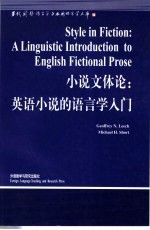
- GeoffreyN.Leech,MichaelH.Short著申丹导读 著
- 出版社: 北京:外语教学与研究出版社
- ISBN:7560023827
- 出版时间:2001
- 标注页数:411页
- 文件大小:17MB
- 文件页数:449页
- 主题词:
PDF下载
下载说明
小说文体论 英语小说的语言学入门 英文版PDF格式电子书版下载
下载的文件为RAR压缩包。需要使用解压软件进行解压得到PDF格式图书。建议使用BT下载工具Free Download Manager进行下载,简称FDM(免费,没有广告,支持多平台)。本站资源全部打包为BT种子。所以需要使用专业的BT下载软件进行下载。如 BitComet qBittorrent uTorrent等BT下载工具。迅雷目前由于本站不是热门资源。不推荐使用!后期资源热门了。安装了迅雷也可以迅雷进行下载!
(文件页数 要大于 标注页数,上中下等多册电子书除外)
注意:本站所有压缩包均有解压码: 点击下载压缩包解压工具
图书目录
INTRODUCTION 1
0.1 Aim 1
0.2 Language in prose and poetry 2
0.3 Where linguistics comesin 4
0.4 The scope and design of this book 6
Notes 8
PartⅠ:Approaches and methods 9
1.1 The domain of style 10
1 STYLE AND CHOICE 10
Preface by Halliday 12
1.2 Stylistics 12
王宗炎序 F 13
1.3 Style and content 14
1.3.1 Style as the dress of thought :one kind of dualism 15
Preface by Chomsky 16
1.3.2 Style as manner of expression:another kind of dualism 19
沈家煊序 23
1.3.3 The inseparability of style and content:monism 24
导读 26
1.4 Comparing monism and dualism 26
1.5 Pluralism:analysing style in terms of functions 29
1.6 A multilevel approach to style 34
Foreword 36
1.7 Conclusion:meanings of style 38
Acknowledgements 38
Notes 40
2 STYLE ,TEXT AND FREQUENCY 42
2.1 The problem of measuring style 43
2.2 The uses of arithmetic 46
2.3 Deviance,prominence,and literary relevance 48
2.4 Relative norms 51
2.5 Primary and secondary norms 54
2.6 Internal deviation 55
2.7 Pervasive and local characteristics of style 56
2.8 Variations in style 57
2.9 Features of style 64
2.10 Style markers and the principle of selection 69
2.11 Conclusion 70
Notes 71
3 A METHOD OF ANALYSIS AND SOME EXAMPLES 74
3.1 A checklist of linguistic and stylistic categories 75
3.2 Notes on the categories 80
3.3 Joseph Conrad:ExampleⅠ 82
3.4 D.H.Lawrence:ExampleⅡ 90
3.5 Henry James:ExampleⅢ 97
3.6 Conclusion 110
3.7 Quantitative appendix 111
Notes 118
4 LEVELS OF STYLE 119
4.1 Language as a cognitive code 119
4.2 Messages and models of reality 124
4.3 An example:Katherine Mansfield 126
4.3.1 The semantic level 127
4.3.2 The syntactic level 130
4.3.3 The graphological level 131
4.3.4 Phonological effects 132
4.4 A justification for studying stylistic variants 133
4.5 Levels and functions 136
4.6 Style and qualitative foregrounding 138
4.7 The remainder of this book 146
Notes 146
PartⅡ:Aspects of style 149
5 LANGUAGE AND THE FICTIONAL WORLD 150
5.1 Language,reality and realism 150
5.2 Reality and mock-reality 153
5.3 Specification of detail:symbolism and redlism 155
5.4 Real speech and fictional speech 159
5.4.1 Realism in conversation 160
5.4.2 Dialect and idiolect 167
5.4.3 Speech and Character 171
5.5 The rendering of the fiction 173
5.5.1 Fictional point of view 174
5.5.2 Fictional sequencing 176
5.5.3 Descriptive focus 180
Notes 185
5.6 Conclusion 185
6 MIND STYLE 187
6.1 How linguistic choices affect mind style 189
6.2 A comparison of three normal mind styles 191
6.3 Some more unusual mind styles 196
6.4 A very unusual mind style 202
6.4.1 General structure 204
6.4.2 Lexis 204
6.4.3 Syntax 205
6.4.4 Textual relations 206
Notes 208
7 THE RHETORIC OF TEXT 209
7.1 The rhetoric of text and discourse 209
7.2 The linearity of text 210
7.3 The Principle of end-focus 212
7.4 Segmentation 214
7.4.1 The‘rhythm of prose’ 215
7.4.2 Segmentation and syntax 217
7.5 Simple and complex sentences 218
7.5.1 Coordination and subordination 220
7.5.2 The principle of climax:‘last is most important’. 222
7.5.3 Periodic sentence structure 225
7.5.4 Loose sentence structure 228
7.6 Addresser-based rhetoric:writing imitating speech 231
7.7 Iconicity:the imitation principle 233
7.7.1 Three principles of sequencing 236
7.7.2 Juxtaposition 239
7.7.3 Other forms of iconicity 242
7.8 Cohesion 243
7.8.1 Cross-reference 246
7.8.2 Linkage 249
7.9 Conclusion 254
Notes 254
8 DISCOURSE AND DISCOURSE SITUATION 257
8.1 The discourse situation of literature 257
8.1.1 Implied author and implied reader 259
8.1.2 Authors and narrators 262
8.1.3 Narrators and characters 269
8.2 Point of view and value language 272
8.3 Multiplicty of values 276
8.4 Irony 277
8.5 Authorial tone 280
8.6 Conclusion 286
Notes 287
9 CONVERSATION IN THE NOVEL 288
9.1 Pragmatics and the interpretation of conversation 288
9.1.1 Speech acts 290
9.1.2 Conversational implicature 294
9.2 Pragmatics and thought 299
9.3 ‘Conversation’between authors and readers 302
9.4 An extended pragmatic analysis 305
9.5 Conversationaltone 309
9.5.1 An example:references to people 310
9.5.2 Other indicators of politeness 312
9.5.3 Politeness and formality 314
Notes 316
9.6 Conclusion 316
10 SPEECH AND THOUGHT PRESENTATION 318
10.1 The presentation of speech 318
10.1.1 Direct and indirect speech(DS and IS) 318
10.1.2 Free direct speech(FDS) 322
10.1.3 The narrative report of speech acts(NRSA) 323
10.1.4 Free indirect speech(FIS) 324
10.1.5 The effects and uses of FIS 334
10.2 The presentation of thought 336
10.2.1 The categorization of thought presen-tation 337
10.2.2 The relationship between inner speech and point of view 341
10.2.3 The uses of the categories of thought presentation 342
10.3 Conclusion 348
Notes 351
Passages and topics for further study 352
Further reading 382
Bibliography 387
Index of works discussed 394
Generalindex 396
文库索引 403