
图书介绍
理论飞秒物理 强激光场中的原子和分子=THEORETICAL FEMTOSECOND PHYSICS:ATOMS AND MOLECULES IN STRONG LASER FIELDS 影印版pdf电子书版本下载
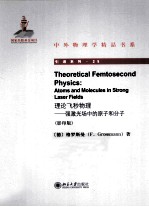
- (德)格罗斯曼著 著
- 出版社: 北京大学出版社
- ISBN:
- 出版时间:2013
- 标注页数:214页
- 文件大小:37MB
- 文件页数:229页
- 主题词:
PDF下载
下载说明
理论飞秒物理 强激光场中的原子和分子=THEORETICAL FEMTOSECOND PHYSICS:ATOMS AND MOLECULES IN STRONG LASER FIELDS 影印版PDF格式电子书版下载
下载的文件为RAR压缩包。需要使用解压软件进行解压得到PDF格式图书。建议使用BT下载工具Free Download Manager进行下载,简称FDM(免费,没有广告,支持多平台)。本站资源全部打包为BT种子。所以需要使用专业的BT下载软件进行下载。如 BitComet qBittorrent uTorrent等BT下载工具。迅雷目前由于本站不是热门资源。不推荐使用!后期资源热门了。安装了迅雷也可以迅雷进行下载!
(文件页数 要大于 标注页数,上中下等多册电子书除外)
注意:本站所有压缩包均有解压码: 点击下载压缩包解压工具
图书目录
Part Ⅰ Prerequisites 3
1 A Short Introduction to Laser Physics 3
1.1 The Einstein Coefficients 3
1.2 Fundamentals of the Laser 6
1.2.1 Elementary Laser Theory 6
1.2.2 Realization of the Laser Principle 8
1.3 Pulsed Lasers 10
1.3.1 Frequency Comb 10
1.3.2 Carrier Envelope Phase 12
1.3.3 Husimi Representation of Laser Pulses 14
1.A Some Gaussian Integrals 15
References 16
2 Time-Dependent Quantum Theory 17
2.1 The Time-Dependent Schr?dinger Equation 17
2.1.1 Introduction 18
2.1.2 Time-Evolution Operator 20
2.1.3 Spectral Information 23
2.1.4 Analytical Solutions for Wavepackets 25
2.2 Analytical Approaches 30
2.2.1 Feynman's Path Integral 30
2.2.2 Semiclassical Approximation 35
2.2.3 Time-Dependent Perturbation Theory 38
2.2.4 Magnus Expansion 40
2.2.5 Time-Dependent Hartree Method 42
2.2.6 Quantum-Classical Methods 43
2.2.7 Floquet Theory 45
2.3 Numerical Methods 48
2.3.1 Orthogonal Basis Expansion 48
2.3.2 Split-Operator FFT Method 52
2.3.3 Alternative Methods of Time-Evolution 56
2.3.4 Semiclassical Initial Value Representations 58
2.A The Royal Road to the Path Integral 65
2.B Variational Calculus 67
2.C Stability Matrix 69
2.D From the HK- to the VVG-Propagator 71
References 72
Part Ⅱ Applications 77
3 Field Matter. Coupling and Two-Level Systems 77
3.1 Light Matter Interaction 77
3.1.1 Minimal Coupling 77
3.1.2 Length Gauge 79
3.1.3 Kramers-Henneberger Transformation 81
3.1.4 Volkov Wavepacket 82
3.2 Analytically Solvable Two-Level Problems 83
3.2.1 Dipole Matrix Element 83
3.2.2 Rabi Oscillations Induced by a Constant Perturbation 84
3.2.3 Time-Dependent Perturbations 86
3.2.4 Exactly Solvable Time-Dependent Cases 89
3.A Generalized Parity Transformation 91
3.B Two-Level System in an Incoherent Field 93
References 95
4 Single Electron Atoms in Strong Laser Fields 97
4.1 The Hydrogen Atom 97
4.1.1 Hydrogen in Three Dimensions 98
4.1.2 The One-Dimensional Coulomb Problem 99
4.2 Field Induced Ionization 101
4.2.1 Tunnel Ionization 101
4.2.2 Multiphoton Ionization 104
4.2.3 ATI in the Coulomb Potential 109
4.2.4 Stabilization in Very Strong Fields 111
4.2.5 Atoms Driven by HCP 113
4.3 High Harmonic Generation 119
4.3.1 Three-Step Model 119
4.3.2 Odd Harmonics Rule 123
4.3.3 Semiclassical Explanation of the Plateau 124
4.3.4 Cutoff and Odd Harmonics Revisited 126
4.A More on Atomic Units 131
References 133
5 Molecules in Strong Laser Fields 135
5.1 The Molecular Ion H2+ 135
5.1.1 Electronic Potential Energy Surfaces 135
5.1.2 The Morse Potential 140
5.2 H2+ in a Laser Field 142
5.2.1 Frozen Nuclei 142
5.2.2 Nuclei in Motion 147
5.3 Adiabatic and Nonadiabatic Nuclear Dynamics 151
5.3.1 Born-Oppenheimer Approximation 152
5.3.2 Dissociation in a Morse Potential 156
5.3.3 Coupled Potential Surfaces 159
5.3.4 Femtosecond Spectroscopy 168
5.4 Control of Molecular Dynamics 177
5.4.1 Control of Tunneling 178
5.4.2 Control of Population Transfer 185
5.4.3 Optimal Control Theory 189
5.4.4 Genetic Algorithms 195
5.4.5 Toward Quantum Computing with Molecules 197
5.A Relative and Center of Mass Coordinates for H2+ 200
5.B Perturbation Theory for Two Coupled Surfaces 201
5.C Reflection Principle of Photodissociation 202
5.D The Undriven Double Well Problem 203
5.E The Quantum Mechanical Adiabatic Theorem 205
References 206
Index 209