
图书介绍
金融衍生品数学模型 英文 原书第2版pdf电子书版本下载
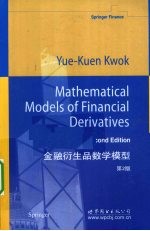
- 郭宇权著 著
- 出版社: 北京:世界图书北京出版公司
- ISBN:9787510005503
- 出版时间:2010
- 标注页数:530页
- 文件大小:18MB
- 文件页数:546页
- 主题词:金融市场-数学模型-英文
PDF下载
下载说明
金融衍生品数学模型 英文 原书第2版PDF格式电子书版下载
下载的文件为RAR压缩包。需要使用解压软件进行解压得到PDF格式图书。建议使用BT下载工具Free Download Manager进行下载,简称FDM(免费,没有广告,支持多平台)。本站资源全部打包为BT种子。所以需要使用专业的BT下载软件进行下载。如 BitComet qBittorrent uTorrent等BT下载工具。迅雷目前由于本站不是热门资源。不推荐使用!后期资源热门了。安装了迅雷也可以迅雷进行下载!
(文件页数 要大于 标注页数,上中下等多册电子书除外)
注意:本站所有压缩包均有解压码: 点击下载压缩包解压工具
图书目录
1 Introduction to Derivative Instruments 1
1.1 Financial Options and Their Trading Strategies 2
1.1.1 Trading Strategies Involving Options 5
1.2 Rational Boundaries for Option Values 10
1.2.1 Effects of Dividend Payments 16
1.2.2 Put-Call Parity Relations 18
1.2.3 Foreign Currency Options 19
1.3 Forward and Futures Contracts 21
1.3.1 Values and Prices of Forward Contracts 21
1.3.2 Relation between Forward and Futures Prices 24
1.4 Swap Contracts 25
1.4.1 Interest Rate Swaps 26
1.4.2 Currency Swaps 28
1.5 Problems 29
2 Financial Economics and Stochastic Calculus 35
2.1 Single Period Securities Models 36
2.1.1 Dominant Trading Strategies and Linear Pricing Measures 37
2.1.2 Arbitrage Opportunities and Risk Neutral Probability Measures 43
2.1.3 Valuation of Contingent Claims 48
2.1.4 Principles of Binomial Option Pricing Model 52
2.2 Filtrations,Martingales and Multiperiod Models 55
2.2.1 Information Structures and Filtrations 56
2.2.2 Conditional Expectations and Martingales 58
2.2.3 Stopping Times and Stopped Processes 62
2.2.4 Multiperiod Securities Models 64
2.2.5 Multiperiod Binomial Models 69
2.3 Asset Price Dynamics and Stochastic Processes 72
2.3.1 Random Walk Models 73
2.3.2 Brownian Processes 76
2.4 Stochastic Calculus:Ito's Lemma and Girsanov's Theorem 79
2.4.1 Stochastic Integrals 79
2.4.2 Ito's Lemma and Stochastic Differentials 82
2.4.3 Ito's Processes and Feynman-Kac Representation Formula 85
2.4.4 Change of Measure:Radon-Nikodym Derivative and Girsanov's Theorem 87
2.5 Problems 89
3 Option Pricing Models:Black-Scholes-Merton Formulation 99
3.1 Black-Scholes-Merton Formulation 101
3.1.1 Riskless Hedging Principle 101
3.1.2 Dynamic Replication Strategy 104
3.1.3 Risk Neutrality Argument 106
3.2 Martingale Pricing Theory 108
3.2.1 Equivalent Martingale Mensure and Risk Neutral Valuation 109
3.2.2 Black-Scholes Model Revisited 112
3.3 Black-Scholes Pricing Formulas and Their Properties 114
3.3.1 Pricing Formulas for European Options 115
3.3.2 Comparative Statics 121
3.4 Extended Option Pricing Models 127
3.4.1 Options on a Dividend-Paying Asset 127
3.4.2 Futures Options 132
3.4.3 Chooser Options 135
3.4.4 Compound Options 136
3.4.5 Merton's Model of Risky Debts 139
3.4.6 Exchange Options 142
3.4.7 Equity Options with Exchange Rate Risk Exposure 144
3.5 Beyond the Black-Scholes Pricing Framework 147
3.5.1 Transaction Costs Models 149
3.5.2 Jump-Diffusion Models 151
3.5.3 Implied and Local Volatilities 153
3.5.4 Stochastic Volatility Models 159
3.6 Problems 164
4 Path Dependent Options 181
4.1 Barrier Options 182
4.1.1 European Down-and-Out Call Options 183
4.1.2 Transition Density Function and First Passage Time Density 188
4.1.3 Options with Double Barriers 195
4.1.4 Discretely Monitored Barrier Options 201
4.2 Lookback Options 201
4.2.1 European Fixed Strike Lookback Options 203
4.2.2 European Floating Strike Lookback Options 205
4.2.3 More Exotic Forms ofEuropean Lookback Options 207
4.2.4 Differential Equation Formulation 209
4.2.5 Discretely Monitored Lookback Options 211
4.3 Asian Options 212
4.3.1 Partial Differential Equation Formulation 213
4.3.2 Continuously Monitored Geometric Averaging Options 214
4.3.3 Continuously Monitored Arithmetic Averaging Options 217
4.3.4 Put-Call Parity and Fixed-Floating Symmetry Relations 219
4.3.5 Fixed Strike Options with Discrete Geometric Averaging 222
4.3.6 Fixed Strike Options with Discrete Arithmetic Averaging 225
4.4 Problems 230
5 American Options 251
5.1 Characterization of the Optimal Exercise Boundaries 253
5.1.1 American Options on an Asset Paying Dividend Yield 253
5.1.2 Smooth Pasting Condition 255
5.1.3 Optimal Exercise Boundary for an American Call 256
5.1.4 Put-Call Symmetry Relations 260
5.1.5 American Call Options on an Asset Paying Single Dividend 263
5.1.6 One-Dividend and Multidividend American Put Options 267
5.2 Pricing Formulations of American Option Pricing Models 270
5.2.1 Linear Complementarity Formulation 270
5.2.2 Optimal Stopping Problem 272
5.2.3 Integral Representation of the Early Exercise Premium 274
5.2.4 American Barrier Options 278
5.2.5 American Lookback Options 280
5.3 Analytic Approximatiou Methods 282
5.3.1 Compound Option Approximation Method 283
5.3.2 Numerical Solution of the Integral Equation 284
5.3.3 Quadratic Approximation Method 287
5.4 Options with Voluntary Reset Rights 289
5.4.1 Valuation of the Shout Floor 290
5.4.2 Reset-Strike Put Options 292
5.5 Problems 297
6 Numerical Schemes for Pricing Options 313
6.1 Lattice Tree Methods 315
6.1.1 Binomial Model Revisited 315
6.1.2 Continuous Limits of the Binomial Model 316
6.1.3 Discrete Dividend Models 320
6.1.4 Early Exercise Feature and Callable Feature 322
6.1.5 Trinomial Schemes 323
6.1.6 Forward Shooting Grid Methods 327
6.2 Finite Difference Algorithms 332
6.2.1 Construction of Explicit Schemes 333
6.2.2 Implicit Schemes and Their Implementation Issues 337
6.2.3 Front Fixing Method and Point Relaxation Technique 340
6.2.4 Truncation Errors and Order of Convergence 344
6.2.5 Numerical Stability and Oscillation Phenomena 346
6.2.6 Numerical Approximation of Auxiliary Conditions 349
6.3 Monte Carlo Simulation 352
6.3.1 Variance Reduction Techniques 355
6.3.2 Low Discrepancy Sequences 358
6.3.3 Valuation of American Options 359
6.4 Problems 369
7 Interest Rate Models and Bond Pricing 381
7.1 Bond Prices and Interest Rates 382
7.1.1 Bond Prices and Yield Curves 383
7.1.2 Forward Rate Agreement,Bond Forward and Vanilla Swap 384
7.1.3 Forward Rates and Short Rates 387
7.1.4 Bond Prices under Deterministic Interest Rates 389
7.2 One-Factor Short Rate Models 390
7.2.1 Short Rate Models and Bond Prices 391
7.2.2 Vasicek Mean Reversion Model 396
7.2.3 Cox-Ingersoll-Ross Square Root Diffusion Model 397
7.2.4 Generalized One-Factor Short Rate Models 399
7.2.5 Calibration to Current Term Structures of Bond Prices 400
7.3 Multifactor Interest Rate Models 403
7.3.1 Short Rate/Long Rate Models 404
7.3.2 Stochastic Volatility Models 407
7.3.3 Affine Term Structure Models 408
7.4 Heath-Jarrow-Morton Framework 411
7.4.1 Forward Rate Drift Condition 413
7.4.2 Short Rate Processes and Their Markovian Characterization 414
7.4.3 Forward LIBOR Processes under Gaussian HJM Framework 418
7.5 Problems 420
8 Interest Rate Derivatives:Bond Options,LIBOR and Swap Products 441
8.1 Forward Measure and Dynamics of Forward Prices 443
8.1.1 Forward Measure 443
8.1.2 Pricing of Equity Options under Stochastic Interest Rates 446
8.1.3 Futures Process and Futures-Forward Price Spread 448
8.2 Bond Options and Range Notes 450
8.2.1 Options on Discount Bonds and Coupon-Bearing Bonds 450
8.2.2 Range Notes 457
8.3 Caps and LIBOR Market Models 460
8.3.1 Pricing of Caps under Gaussian HJM Framework 461
8.3.2 Black Formulas and LIBOR Market Models 462
8.4 Swap Products and Swaptions 468
8.4.1 Forward Swap Rates and Swap Measure 469
8.4.2 Approximate Pricing of Swaption under Lognormal LIBOR Market Model 473
8.4.3 Cross-Currency Swaps 477
8.5 Problems 485
References 507
Author Index 517
Subject Index 521