
图书介绍
电子电信工程专业英语 第2版pdf电子书版本下载
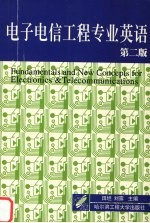
- 田坦,刘露主编 著
- 出版社: 哈尔滨:哈尔滨工程大学出版社
- ISBN:7810736167
- 出版时间:2004
- 标注页数:374页
- 文件大小:95MB
- 文件页数:384页
- 主题词:电子技术(学科: 英语) 电信(学科: 英语) 电子技术 英语 电信
PDF下载
下载说明
电子电信工程专业英语 第2版PDF格式电子书版下载
下载的文件为RAR压缩包。需要使用解压软件进行解压得到PDF格式图书。建议使用BT下载工具Free Download Manager进行下载,简称FDM(免费,没有广告,支持多平台)。本站资源全部打包为BT种子。所以需要使用专业的BT下载软件进行下载。如 BitComet qBittorrent uTorrent等BT下载工具。迅雷目前由于本站不是热门资源。不推荐使用!后期资源热门了。安装了迅雷也可以迅雷进行下载!
(文件页数 要大于 标注页数,上中下等多册电子书除外)
注意:本站所有压缩包均有解压码: 点击下载压缩包解压工具
图书目录
Part Ⅰ 1
Lesson 1 Periodic Signkals 1
1.1 Time-Domain Descriptions 1
1.2 Frequency-Domain Descriptions 3
1.3 Orthogonal Functions 4
1.4 The Fourier Series 7
词汇 11
Lesson 2 Aperiodic Signals 14
2.1 Introduction 14
2.2 The Exponential Form of the Fourier Series 14
2.3 The Fourier Transform 16
2.4 The Laplace Transform 26
词汇 31
Lesson 3 Sampled-Data Signals 33
3.1 Introduction 33
3.2 Mathematical Description Using the Dirac Function 33
3.3 Spectra of Sampled-Data Signals 36
3.4 The z-Transform 39
3.5 Discussion 47
词汇 49
Lesson 4 Random Signals 50
4.1 Introduction 50
4.2 Elements of Probability Theory 53
4.3 Amplitude Distributions and Moments 59
4.4 The Autocorrelation and Power Spectral Density Functions 62
4.5 Important Types of Random Signal 69
词汇 87
Lesson 5 Signals and Systems 89
5.1 Introduction 89
5.2 Basic Aspects of Linear Processing 90
5.3 Convolution,Correlation and Filtering 102
5.4 The Processing of Random Signals 105
5.5 Nonlinear Processing 111
词汇 113
Lesson 6 Modulation and Sampling 116
6.1 Introduction to Modulation 116
6.2 Signal Sampling and Reconstitution 118
6.3 Other Modulation Processes 125
词汇 133
Lesson 7 Filters 135
7.1 Introduction 135
7.2 General Aspects of Filter Performance 136
7.3 Analogue Filters 140
7.4 Digital Filters 143
词汇 151
Part Ⅱ 152
Lesson 8 Underwater Acoustic Signal Processing 152
8.1 Quantitative Description of Signal 152
8.2 Qualitative Description of the Sources of Noise 155
8.3 Comparison of Sonar,Radar,and Seismic Parameters 157
8.4 Target Strength and the Sonar Range Equation 161
8.5 Reflection and Scattering from Boundaries 163
8.6 Effects of an Inhomogeneous Medium 165
8.7 Criteria for Measuring the Success of Detection 166
8.8 Directional Arrays 168
词汇 169
Lesson 9 Underwater Acoustic Imaging 173
9.1 Introduction 173
9.2 Properties of Underwater Acoustic Imaging Systems 174
9.3 Targets and Environmental Requirements 176
9.4 Underwater Acoustic Imaging System Concepts 178
9.5 Examples of Various Acoustic Imaging Techniques and Systems 182
9.6 Summary 190
词汇 191
Lesson 10 Computer Technology 194
10.1 History of Computing 194
10.2 Organization of a Stored Program Digital Computer 198
词汇 208
Lesson 11 Images and Graphics 211
11.1 Basic Concepts of Images and Graphics 211
11.2 Computer Image Processing 217
词汇 231
Lesson 12 Communication Technology 233
12.1 Basic Knowledge of Communication 233
12.2 Introduction to Optical Fiber Communication 239
12.3 Satellite Communication 244
12.4 Data Communication and Mobile Communication 247
词汇 253
Lesson 13 Communication Networks 257
13.1 Principle for Communication Network 257
13.2 ISDN 261
13.3 ATM Networks 269
13.4 Information Network System 273
词汇 278
Part Ⅲ 281
Lesson 14 The Software Radio Architecture 281
14.1 Introduction 281
14.2 Software Radio Overview 286
14.3 Partitioning of the Channel Processing Stream 290
14.4 Estimating Resource Requirements 297
14.5 Heterogeneous Muhiprocessing Hardware 302
14.6 Open Architecture Software Tools Remain Problematic 304
14.7 Conclusions 305
词汇 307
Lesson 15 Smart Antenna Systems 308
15.1 Introduction 308
15.2 A Useful Analogy for Adaptive Smart Antennas 308
15.3 Antennas and Antenna Systems 309
15.4 What Is a Smart Antenna System? 315
15.5 The Goals of a Smart Antenna System 318
15.6 Signal Propagation:Multipath and Cochannel Interference 319
15.7 The Architecture of Smart Antenna Systems 324
15.8 Who Can Use Smart Antenna Technology? 330
词汇 331
Lesson 16 Bluetooth:Technology for Short-Range Wireless Approches 333
16.1 Introduction 333
16.2 Bluetooth Specifications 334
16.3 Radio Front End 337
16.4 Piconets and Scatternets 339
16.5 Piconet Channel 343
16.6 Putting the Pieces Together 349
16.7 Conclusion 350
词汇 351
Lesson 17 Next-Generation Wireless Communications Concepts and Technologies 353
17.1 Introduction 353
17.2 Ubiquitous Services and Paradigm Change 356
17.3 Smart Specturm and Dynamic Spectrum Assignment 359
17.4 Smart Resources:a Technological Vision 360
17.5 Adaptation 363
17.6 Software Radio and Smart Radio 368
17.7 Advanced Adaptive Waveforms and Physical Layer 370
17.8 Qos,Adaptive Networks,and Universal Access Nodes 372
17.9 Conclusion 373
词汇 374