
图书介绍
基于语料库的中国学习者英语口语中语用标记语研究 英文pdf电子书版本下载
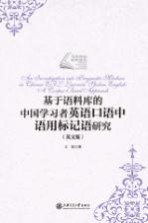
- 王丽著 著
- 出版社: 上海:上海交通大学出版社
- ISBN:9787313140678
- 出版时间:2015
- 标注页数:227页
- 文件大小:30MB
- 文件页数:248页
- 主题词:英语-口语-研究-英文
PDF下载
下载说明
基于语料库的中国学习者英语口语中语用标记语研究 英文PDF格式电子书版下载
下载的文件为RAR压缩包。需要使用解压软件进行解压得到PDF格式图书。建议使用BT下载工具Free Download Manager进行下载,简称FDM(免费,没有广告,支持多平台)。本站资源全部打包为BT种子。所以需要使用专业的BT下载软件进行下载。如 BitComet qBittorrent uTorrent等BT下载工具。迅雷目前由于本站不是热门资源。不推荐使用!后期资源热门了。安装了迅雷也可以迅雷进行下载!
(文件页数 要大于 标注页数,上中下等多册电子书除外)
注意:本站所有压缩包均有解压码: 点击下载压缩包解压工具
图书目录
CHAPTER 1 INTRODUCTION 1
1.1 Research background 3
1.2 Research objectives 5
1.3 The organization of this book 6
CHAPTER 2 LITERATURE REVIEW 9
2.1 Defining discourse marker and prag matic marker 11
2.2 The characteristics of pragmatic markers 15
2.3 Research on pragmatic markers in China 17
2.4 Different approaches to discourse 19
2.4.1 Formal approaches to discourse 21
2.4.2 Functional approaches to discourse 22
2.4.3 Corpus-based approaches to discourse 24
2.5 SLA theories:a cognitive approach 25
2.5.1 Schmidt's construct of noticing 26
2.5.2 Formal instruction 29
2.5.3 The information-processing approach 31
2.5.4 VanPattern and input processing 38
2.6 Approaches to pragmatic markers 41
2.6.1 Coherence-based approach to pragmatic markers 41
2.6.2 Relevance-based approach to pragmatic markers 51
2.6.3 Differences between coherence-based approach and relevance-based approach to pragmatic markers 65
2.6.4 González's approach to pragmatic markers 68
2.6.5 A tentative theoretical framework of pragmatic markers 70
2.7 Summary 74
CHAPTER 3 RESEARCH DESIGN 75
3.1 Introduction 77
3.2 Research methodology 77
3.2.1 Corpus linguistics 77
3.2.2 Contrastive interlanguage analysis 81
3.2.3 Design and method 84
3.3 Corpora used in the present study 86
3.4 Statistical and computer tools 87
3.4.1 Concordance software 87
3.4.2 Detagging software 87
3.4.3 Statistical tools 87
CHAPTER 4 WELL AS A PRAGMATIC MARKER 91
4.1 Introduction 93
4.2 Previous studies on the use of well 93
4.3 Results and discussion 97
4.3.1 The functional categories of well in this study 97
4.3.2 Contrastive analysis 104
4.4 Interim Summary 111
CHAPTER 5 I MEAN AS A PRAGMATIC MARKER 113
5.1 Introduction 115
5.2 Previous studies on the use of I mean 115
5.3 Results and discussion 118
5.3.1 The functional categories of I mean in this study 118
5.3.2 Comparative analysis 123
5.4 Interim summary 130
CHAPTER 6 YOU KNOW AS A PRAGMATIC MARKER 133
6.1 Introduction 135
6.2 Previous studies on the use of you know 135
6.3 Results and discussion 139
6.3.1 The functional categories of you know in this study 139
6.3.2 Comparative analysis 143
6.4 Interim summary 149
CHAPTER 7 ACTUALLY AS A PRAGMATIC MARKER 151
7.1 Introduction 153
7.2 Previous studies on the use of actually 153
7.3 Results and discussion 157
7.3.1 The functional categories of actually in this study 157
7.3.2 Comparative analysis 161
7.4 Interim summary 165
CHAPTER 8 COMPARATIVE ANALYSIS OF THE PRAGMATIC MARKERS BETWEEN BNC AND SECCL 167
8.1 Introduction 169
8.2 Results 169
8.2.1 Frequency of the pragmatic markers used in BNC and SECCL 170
8.2.2 Range of the pragmatic functions used in BNC and SECCL 172
8.2.3 Distribution of individual pragmatic function in BNC and SECCL 173
8.2.4 Distribution of the pragmatic markers in respective pragmatic structure 176
8.2.5 Distribution of overall syntactic positions in BNC and SECCL 177
8.3 General discussion 179
8.3.1 Underuse of the pragmatic markers and functions by Chinese EFL learners 179
8.3.2 Overuse of the pragmatic functions in the inferential structure by Chinese EFL learners 181
8.3.3 Possible factors facilitating the acquisition of pragmatic markers 183
8.4 Interim summary 187
CHAPTER 9 CONCLUSION 189
9.1 Introduction 191
9.2 Summary of the major findings 191
9.3 Pedagogical implications 194
9.3.1 Consciousness raising 194
9.3.2 Explicit instruction 198
9.3.3 The I-I-I-I teaching methodology 203
9.4 Limitations of this study 205
9.5 Suggestions for future study 206
REFERENCES 207
INDEX 223