
图书介绍
FERROELECTRICITY IN CRYSTALSpdf电子书版本下载
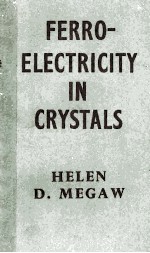
- HELEN D. MEGAW 著
- 出版社: METHUEN AND CO LTD.
- ISBN:
- 出版时间:1957
- 标注页数:220页
- 文件大小:51MB
- 文件页数:226页
- 主题词:
PDF下载
下载说明
FERROELECTRICITY IN CRYSTALSPDF格式电子书版下载
下载的文件为RAR压缩包。需要使用解压软件进行解压得到PDF格式图书。建议使用BT下载工具Free Download Manager进行下载,简称FDM(免费,没有广告,支持多平台)。本站资源全部打包为BT种子。所以需要使用专业的BT下载软件进行下载。如 BitComet qBittorrent uTorrent等BT下载工具。迅雷目前由于本站不是热门资源。不推荐使用!后期资源热门了。安装了迅雷也可以迅雷进行下载!
(文件页数 要大于 标注页数,上中下等多册电子书除外)
注意:本站所有压缩包均有解压码: 点击下载压缩包解压工具
图书目录
1.INTRODUCTION 1
1.Dielectric hysteresis 1
2.The Curie point 4
3.Dielectric constant 5
4.Crystal symmetry and the existence of spontaneous polarization 6
5.Dipole moment and dipoles 8
6.Nature of transition at the Curie point:pseudosymmetric structures 10
7.Twinning and domain formation 12
8.Other materials 13
9.Summary of properties of ferro-electries;definition 14
10.Antiferroelectrics 15
11.Relation between ferroelectrics and antiferroelectrics:line and cone ferroelectrics 16
12.Polymorphism in ferroelectric and antiferroelectric materials;'multiple structures',sub-cells and superlattices 18
13.Paraeleetrics 18
2.ROCHELLE SALT 20
1.Orthorhombic crystal structure 20
2.Evidence for monoclinic symmetry,and location of hydrogen atoms 24
3.Chemical discon-tinuity at the Curie point 27
4.Isomorphous substances 27
5.Curie points and effects of pressure 27
6.Thermal expansion and change of lattice parameters 28
7.Specific heat 29
8.Dielectric constant 30
9.Spontaneous polarization and coercive field 31
10.Barkhausen jumps and Weiss domains:pyroelectric effect 32
11.Discussion:mechanism of the transition 33
3.THE TETRAGONAL PHOSPHATES 35
1.Introduction:potassium dihydrogen phosphate 35
2.Crystal structure at room temperature 35
3.Low-temperature structure 39
4.Domain texture 43
5.Isomorphous substances 44
6.Ammonium salts 45
7.Lattice parameters and thermal expansion 47
8.Specific heat and entropy 48
9.Spontaneous polarization and coercive field 50
10.Effect of field on crystal structure 52
11.Dielectric constant 53
12.Discussion:nature of transition 54
4.BARIUM TITANATE 58
1.Introduction 58
2.Cubic(high-temperature)structure 58
3.Tetragonal structure 59
4.Orthorhombic structure;choice of axes of reference 62
5.Rhombohedral structure 64
6.Hexagonal barium titanate 65
7.Cell dimensions and thermal expansion 65
8.Twinning and domain texture;twin laws,X-ray and optical evidence 67
9.Optical properties 70
10.Latent heat,specific heat,and change of entropy 71
11.Spontaneous polarization and coercive field 73
12.Pyroelectric effect 73
13.Dielectric constant 73
14.Changes in the Curie point:effects of pressure,solid solution,and biassing field 77
15.Domain boundaries and effect of field 79
16.Nature of transition 80
5.THE PEROVSKITE FAMILY 83
1.Introduction:Goldschmidt's rules for ionic structures,and classi-fication of the perovskite family 83
2.Titanates of alkaline earth metals 89
3.Zirconates and hafnates of alkaline earth metals 92
4.Niobates and tantalates of sodium,potassium,and rubidium 93
5.Lithium niobate type 103
6.Tungsten trioxide 106
7.Lead titanate 108
8.Lead zirconate 111
9.Lead hafnate 112
10.Solid solutions of lead compounds 114
11.Lead compounds:summary 120
6.DISCUSSION OF DISTORTED PEROVSKITE STRUCTURES 124
1.Introduction:two types of distortion 124
2.Packing distortion or crumpling:tilting of octahedra 124
3.'Off-centre'distortion:role of covalent bonds 126
4.Behaviour of lead compounds 130
5.Relation of dis-tortion to ferroelectricity and antiferroelectricity 131
6.Multiple cell:relation to electrical properties 133
7.Summary 133
7.MISCELLANEOUS STRUCTURES 135
1.Introduction 135
2.Double tartrates of lithium 135
3.Guanidine alu-minium Sulphate hexahydrate 137
4.Lithium niobate(referred to perovskite family) 137
5.Periodates 137
6.Pyrochlore group:cadmium niobate and isomorphous compounds 142
8.THEORIES OF FERROELECTRICITY:THE PHENOMENOLOGICAL APPROACH 150
1.Introduction:comparison of phenomenological and model theories 150
2.Devonshire's theory of barium titanate 151
3.Mueller's theory of Rochelle salt 160
4.Comment on the phenomenological theories 161
5.Phenomenological theory of antiferroelectricity:exist-ence of'mixed states'(cone ferroelectrics) 162
9.MODEL THEORIES:GENERAL BACKGROUND 165
1.Introductory ideas:origin and nature of dipoles;long-range and short-range forces 165
2.Polarization and susceptibility in terms of long-range forces 166
3.The internal field 168
4.Polarizability:Clausius-Mosotti relation;additivity of polarizabilities of atoms;electronic and ionic polarizabilities 170
5.Construction of a model theory:necessary postulates 176
l0.MODEL THEORIES:PARTICULAR APPLICATIONS 179
1.Introduction 179
2.Rochelle salt:theories of Kurchatov and of Fowler 179
3.Mason's theory of Rochelle salt 179
4.Slater's theory of potassium dihydrogen phosphate 183
5.Mason's treatment of potassium dihydrogen phosphate 186
6.Pirenne's theory of potassium dihydrogen phosphate 187
7.Mason and Matthias's theory of barium titanate 188
8.Devonshire's model-theory of barium titanate:potential energy of atom 191
9.Slater's theory of barium titanate:relation to Devon-shire's treatment of ionic and electronic polarizabilities,and field factor 192
10.Jaynes's mechanical-deformation treatment of barium titanate 197
11.Jaynes's electronic theory of barium titanate 197
12.Structural approach:postulates and outline of treatment in terms of short-range forces 199
APPENDIX:GLOSSARY OF CRYSTALLO-GRAPHIC TERMS 203
INDEX 212
精品推荐
- Northanger Abbey(1818)
- Emma(1815)
- Sense And Sensibility(1811)
- Mansfield Park(1814)
- HUMANITIES THE EVOLUTION OF VALUES
- Pride And Drejudice(1812)
- English
- 企鹅经济学词典 经济学
- 大人的友情 河合隼雄谈友谊
- Computing Concepts
- Advanced Compilpr Design and lmplementation
- 中国商事法律要览
- Introduction to polymers
- CONFICT OF LAWS IN THE WESTERN SOCIALIST AND DEVELOPING COUNTRIES
- Measurement and Research Methods in International Marketing