
图书介绍
法律语篇权力意志研究pdf电子书版本下载
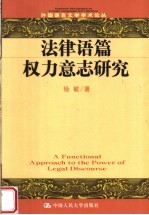
- 杨敏著(中国人民大学) 著
- 出版社: 北京:中国人民大学出版社
- ISBN:9787300084015
- 出版时间:2007
- 标注页数:303页
- 文件大小:9MB
- 文件页数:322页
- 主题词:权利-法律语言学-研究;意志-法律语言学-研究
PDF下载
下载说明
法律语篇权力意志研究PDF格式电子书版下载
下载的文件为RAR压缩包。需要使用解压软件进行解压得到PDF格式图书。建议使用BT下载工具Free Download Manager进行下载,简称FDM(免费,没有广告,支持多平台)。本站资源全部打包为BT种子。所以需要使用专业的BT下载软件进行下载。如 BitComet qBittorrent uTorrent等BT下载工具。迅雷目前由于本站不是热门资源。不推荐使用!后期资源热门了。安装了迅雷也可以迅雷进行下载!
(文件页数 要大于 标注页数,上中下等多册电子书除外)
注意:本站所有压缩包均有解压码: 点击下载压缩包解压工具
图书目录
Chapter One Introduction 1
1.1 Rationale of the Study 1
1.1.1 An Urgent Need for Discourse Analysis 1
1.1.2 The Importance of Legal Discourse 2
1.1.3 A Need for Research of Legislative Discourse 5
1.2 Aims of the Present Study 7
1.3 Research Methodology and Data Collection 8
1.4 Organization of the Dissertation 8
Chapter Two Literature Review 11
2.1 Introduction 11
2.2 Discourse Analysis(DA) 12
2.2.1 The Philosophical Origins of Discourse Analysis 12
2.2.2 Contributions of Linguists to DA 15
2.2.3 Three Strategies of Discourse Analysis(DA) 16
2.3 Critical Discourse Analysis(CDA) 18
2.3.1 Introduction to CDA 18
2.3.2 Three Major Issues of CDA 19
2.3.3 Approaches to CDA 24
2.3.4 Limitations in CDA 30
2.4 A Systemic Functional Approach to DA 32
2.5 Legal Discourse Analysis 39
2.5.1 Studies in Legal Language-as-object 39
2.5.2 Studies in Language-as-process 41
2.5.3 Studies in legal language-as-instrument 42
2.5.4 Current Domestic Research on Legal Discourse 44
2.5.5 Analysis of Legislative Discourse of the Present Dissertation 45
2.6 Summary 46
Chapter Three Theoretical Framework of the Present Research 47
3.1 Introduction 47
3.2 Evaluation of Thompson's Methodological Framework 47
3.2.1 Strengths of Thompson's Framework 47
3.2.2 Limitations of Thompson's Framework 52
3.3 Evaluation of the Hallidayan Model 54
3.3.1 Strengths of the Hallidayan Model 54
3.3.2 Limitations of SFG 56
3.4 A Critical-Functional Framework 56
3.5 Data Collection 61
3.6 Summary 63
Chapter Four The Power of Legislative Discourse in Contexts of Culture & Situation 65
4.1 Introduction 65
4.2 Power in Context of Culture of Legislative Discourse 66
4.2.1 Concept of Context of Culture 66
4.2.2 Genre 66
4.2.3 Spacio-temporal Settings of Legislative Discourse 68
4.2.4 Schematic Structure and Analysis of Its Ideology in Legislative Discourse 72
4.2.5 The Power in Realizational Patterns 77
4.3 Analysis of Situational Context 84
4.3.1 Power in Fields of Interaction & Social Institutions 85
4.3.2 Power in Social Structure 93
4.3.3 Power in Technical Transmission Media 96
4.4 Summary 104
Chapter Five Power in the Ideational Function 107
5.1 Introduction 107
5.2 The Power of Logical Function in Legislative Discourse 108
5.2.1 The Concept of Logical Function 108
5.2.2 The History of the Development of Logical Progression of Statutes 109
5.2.3 Analysis of Logical Structure of the Statutes 111
5.2.4 Power in Logical Function of Legislative Discourse 125
5.3 The Power of Experiential Function 128
5.3.1 Processes in the Legislative Discourse 128
5.3.2 Circumstances in Experiential Function 144
5.3.3 Experiential Metaphor(Grammatical Metaphor) 146
5.4 Summary 148
Chapter Six Power in the Interpersonal Function 151
6.1 Introduction 151
6.2 The Definition of Interpersonal Function 151
6.3 Modality in Legislative Discourse 155
6.4 Participants in the Legislative Discourses 174
6.5 Summary 176
Chapter Seven Textual Function of Legislative Discourse 179
7.1 Introduction 179
7.2 Textual Function 179
7.3 Thematic Structure in Legislative Discourse 180
7.3.1 Theme Types 181
7.3.2 The Pattern of Thematic Progression of Legislative Discourse 192
7.4 Power in Information Structure 198
7.5 Cohesion System 203
7.6 Summary 207
Chapter Eight Vagueness in Lexicon 209
8.1 Introduction 209
8.2 Vagueness in Legislative Discourse 210
8.2.1 The Tension Between Vagueness and Precision 210
8.2.2 Ineliminability of Vagueness 215
8.2.3 Vagueness as a Defect in Legislative Discourse 216
8.3 Other Characteristics of Lexicon in Legislative Discourse 219
8.4 Summary 221
Chapter Nine Interpretation of Legislative Discourse 223
9.1 Introduction 223
9.2 The Concept of"Interpretation" 223
9.2.1 The Interpretation Theory of Ideology 223
9.2.2 Some Critical Legal Theories on Interpretation of Power 224
9.3 The Nature of Legislative Discourse 227
9.4 Functions of Law 229
9.4.1 Regulating Society 230
9.4.2 Balancing Interests 231
9.4.3 Educational Function 232
9.4.4 Adjusting Economy 233
9.4.5 Maintaining Historical Continuity and Consistency of Doctrine 233
9.5 Analyzing the Ideology in Legislative Discourse 234
9.5.1 The Sovereign Power of the State 235
9.5.2 The Inequality Between Legal Professionals and Laymen 236
9.5.3 The Real Inequality Behind the Superficial Equality in Legislature 237
9.5.4 The Arbitrary Use of power—a tendency 240
9.6 The Interactive Relationship Between Language and Power 240
9.6.1 Language Has Power 240
9.6.2 Power Selects Language 241
9.7 Summary 243
Chapter Ten Conclusion 245
10.1 Major Conclusions of the Present Study 245
10.2 Contributions of the Current Research 249
10.3 Limitations and Suggestions for Future Research 249
Appendix Ⅰ-Ⅹ 253
Bibliography 291