
图书介绍
中动结构的认知阐释pdf电子书版本下载
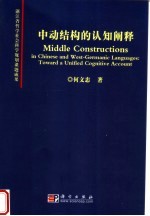
- 何文忠著 著
- 出版社: 北京:科学出版社
- ISBN:7030191749
- 出版时间:2007
- 标注页数:281页
- 文件大小:10MB
- 文件页数:305页
- 主题词:句法结构-对比研究-日耳曼语族、汉语
PDF下载
下载说明
中动结构的认知阐释PDF格式电子书版下载
下载的文件为RAR压缩包。需要使用解压软件进行解压得到PDF格式图书。建议使用BT下载工具Free Download Manager进行下载,简称FDM(免费,没有广告,支持多平台)。本站资源全部打包为BT种子。所以需要使用专业的BT下载软件进行下载。如 BitComet qBittorrent uTorrent等BT下载工具。迅雷目前由于本站不是热门资源。不推荐使用!后期资源热门了。安装了迅雷也可以迅雷进行下载!
(文件页数 要大于 标注页数,上中下等多册电子书除外)
注意:本站所有压缩包均有解压码: 点击下载压缩包解压工具
图书目录
Chapter 1 Introduction 1
1.1 Middle constructions in languages 1
1.2 The middle construction and middle semantics 3
1.3 Studies on middles:past and present 7
1.4 Methodology and procedures 12
1.5 Goals of this study 13
1.6 A sketch map of the thesis 14
Chapter 2 Characteristics of Middles in West-Germanic Languages2.1 Semantic classification of middles 17
2.2 The syntactic features of middles in West-Germanic languages 20
2.2.1 Passive-participant subject and active morphology 20
2.2.2 Tense and aspect 21
2.2.3 Adverbial 22
2.3 Semantic characteristics of middles in West-Germanic languages 23
2.3.1 Agent irrelevance and the implicit argument 24
2.3.2 Time-irrelevance and genericity,non-eventiveness 27
2.3.3 Passive participant and responsibility of subject,causative modality 30
2.4 Selectional restrictions on verbs and adverbials in middles 32
2.4.1 Middable verbs 32
2.4.2 Selectional restriction on adverbial 33
2.5 Summary 35
Chapter 3 The Realization of Middle Semantics in Chinese3.1 Chinese qilai construction 37
3.2 A preliminary syntactic analysis of the qilai construction 38
3.2.1 Chinese qilai construction is not an elliptical structure 38
3.2.2 The structural parsing of qilai construction 41
3.2.3 Chinese qilai construction is active in morphology 43
3.3 Middle voice verbs and the middle construction 44
3.4 The realization of middle semantics in the qilai construction 46
3.4.1 The implicit argument and the irrelevance of agent 46
3.4.2 The realization of non-eventiveness 48
3.4.3 Modality and responsibility of subject 52
3.4.4 Genericity 54
3.4.5 Adverb and adverbial effect 55
3.5 Restrictions on qilai construction 57
3.6 The status and function of qilai 59
3.7 Other issues in middles 61
3.7.1 对于/就……而言/来说and for-phrase 61
3.7.2 自己and oneself in middles 64
3.8 Summary 66
Chapter 4 Atypical Middles in Chinese and West-Germanic languages4.1 Syntactic classification of middles 67
4.2 Adjunct middles in West-Germanic languages 69
4.2.1 What is adjunct? 69
4.2.2 The features of adjunct middles 70
4.3 Adjunct middles in Chinese 75
4.3.1 Are there adjunct middles in Chinese? 75
4.3.2 The syntactic and semantic features 77
4.3.3 Types of adjuncts in the adjunct middles 77
4.4 The difference between typical and adjunct middles 80
4.5 Adjunct middles in Topic-prominent Chinese 82
4.6 Adjunct middles and instrument-subject clauses 83
4.7 Diverse semantic relations between Chinese verbs and their objects 86
4.8 Impersonal middles 88
4.9 Summary 91
Chapter 5 Middles and Tough Constructions 92
5.1 Two hot topics in the past 25 years 92
5.2 Chinese nanyi construction and English tough construction 93
5.3 Asymmetry between TC and MC 97
5.4 A systematic comparison between TC and facility MC 99
5.4.1 The irrelevance of agent and the implicit argument 99
5.4.2 Genericity and non-eventiveness 102
5.4.3 Modality and responsibility of subject 103
5.4.4 Tough predicates and middle adverb 104
5.4.5 Aspectual classes of verb and Affectedness constraint 107
5.4.6 The subject of TCs and MCs 110
5.4.7 Semantic Compatibility 111
5.5 Summary 114
Chapter 6 Middles and Syntactically Similar Constructions6.1 Introduction 115
6.2 English middles and ergatives 115
6.3 English middles and intransitive actives 121
6.4 Middles and transitive actives 123
6.5 The meaning of the construction 124
6.6 Other types of qilai constructions 125
6.7 Other types of nanyi constructions 128
6.8 Other types of reflexive constructions in German 129
6.9 Summary 131
Chapter 7 The Two MF Approaches and Their Problems7.1 The movement and non-movement approaches to MF 133
7.2 The main arguments of the Movement Approach 135
7.3 The dilemma for the Movement Approach to MF 136
7.3.1 Not every middle construction has its active counterpart 137
7.3.2 Not every active sentence has middle counterpart 139
7.3.3 Middles often differ from their active paraphrases in meaning 140
7.3.4 Restrictions on middle formation are not accounted for 141
7.3.5 Atypical middles 141
7.3.6 Impersonal middles 145
7.4 Major arguments of the lexical approach 145
7.5 Problems of the lexical approach 147
7.6 Summary 148
Chapter 8 A Cognitive Approach to Middle Construction8.1 The need of a new account 151
8.2 Theoretical framework 152
8.3 The middle profile 160
8.4 The construction of meaning and the meaning of construction 170
8.5 Middle construction and virtual reality 172
8.6 Events and properties 176
8.7 Chinese qilai constructions 176
8.8 Impersonal middles and the reflexive sich in German 178
8.9 Summary 182
Chapter 9 Conditions on Middle Formation 183
9.1 The restriction on MF is a notorious question 183
9.2 The condition on MF 184
9.2.1 Aspectuality Condition 186
9.2.2 Responsibility Condition 189
9.2.3 The interpretive power of the two conditions 196
9.3 Other factor saffecting the acceptability of middles 202
9.3.1 Semantic compatibility 202
9.3.2 Pragmatic factors 203
9.3.3 Asymmetry between ease and difficulty 204
9.3.4 Ambiguity between active and middle interpretations 206
9.4 Productivity of middles 208
9.5 The selection restrictions on MF 210
9.6 Summary 212
Chapter 10 Integrating the Features of Middles10.1 Two central properties of middles 213
10.2 Integrating IA,AM and AE 214
10.3 Integrating tense,genericity and non-eventiveness 218
10.4 Summary 227
Chapter 11 Conclusion 229
11.1 Major findings of this study 229
11.2 Implications of this study 234
11.3 Limitations of this study 235
11.4 Suggestions for further research 236
References 238
Author Index 256
Subject Index 259