
图书介绍
相邻关系 汉语反语的认知语用研究pdf电子书版本下载
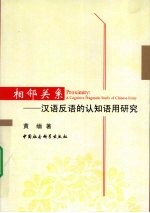
- 黄缅著 著
- 出版社: 北京:中国社会科学出版社
- ISBN:9787500477037
- 出版时间:2009
- 标注页数:266页
- 文件大小:28MB
- 文件页数:279页
- 主题词:汉语-认知科学:语用学-研究
PDF下载
下载说明
相邻关系 汉语反语的认知语用研究PDF格式电子书版下载
下载的文件为RAR压缩包。需要使用解压软件进行解压得到PDF格式图书。建议使用BT下载工具Free Download Manager进行下载,简称FDM(免费,没有广告,支持多平台)。本站资源全部打包为BT种子。所以需要使用专业的BT下载软件进行下载。如 BitComet qBittorrent uTorrent等BT下载工具。迅雷目前由于本站不是热门资源。不推荐使用!后期资源热门了。安装了迅雷也可以迅雷进行下载!
(文件页数 要大于 标注页数,上中下等多册电子书除外)
注意:本站所有压缩包均有解压码: 点击下载压缩包解压工具
图书目录
Chapter 1 Introduction 1
1.1 Preliminary remarks 1
1.2 The commitment of the study 4
1.3 The story of irony 6
1.3.1 Origin 6
1.3.2 Irony in Chinese context 7
1.3.3 Classification 11
1.3.4 Uses and functions 16
1.3.5 Summary of the section 21
1.4 Scope of the study 22
1.5 Methodological issues 22
1.5.1 Lead-in remarks 22
1.5.2 Research phases 24
1.6 Data 25
1.7 Structure of the dissertation 26
1.8 Summary 27
Chapter 2 Literature Review 29
2.1 Introduction 29
2.2 Historical survey 30
2.2.1 Greek 30
2.2.2 Latins 33
2.2.3 Mediaeval and Renaissance 35
2.2.4 Early modern times 38
2.2.5 Modern times 40
2.2.6 Brief summary 44
2.3 Theoretical survey abroad 45
2.3.1 Initial remarks 45
2.3.2 Non-cognitive-pragmatic studies 45
2.3.3 Cognitive-pragmatic studies 49
2.3.4 Summary 60
2.4 Research in Chinese context 67
2.4.1 Preliminaries 67
2.4.2 Chronological survey 69
2.5 Remaining crucial problem 75
2.6 Summary 76
Chapter 3 Theoretical Framework 77
3.1 Preliminaries 77
3.2 Methodological constraints 79
3.3 Theoretical background of the present study 81
3.3.1 Main assumptions of cognitive linguistics 82
3.3.2 A brief survey of cognitive pragmatics 88
3.3.3 Theories of human cognitive abilities 94
3.4 Towards a unified theoretical framework 118
3.4.1 MM-based pragmatic reasoning 119
3.4.2 Explicit expression-implicit expression inference 125
3.4.3 Autonomy-dependence alignment 128
3.5 Summary 133
Chapter 4 Issues of Definition and Taxonomy Revisited 136
4.1 Introduction 136
4.2 Definitions of irony revisited 137
4.2.1 Initial remarks 137
4.2.2 Classical identification 138
4.2.3 Modifications 140
4.2.4 Definitions in Chinese context 142
4.3 Three claims reconsidered 143
4.4 Working definition of fan yu 146
4.5 Classification revisited 148
4.6 Taxonomy of verbal irony 152
4.6.1 Positive attitude irony 154
4.6.2 Negative attitude irony 161
4.7 Summary 170
Chapter 5 Irony as a cognitive-pragmatic phenomenon 172
5.1 Introduction 172
5.2 Chinese irony and its pragmatic features 174
5.2.1 Speaker's intention 174
5.2.2 Cancellability 176
5.2.3 Pragmatic vagueness 177
5.2.4 Contextual constraints 179
5.2.5 Indirect communicative act 184
5.3 Chinese irony and its pragmatic functions 186
5.3.1 Sarcasm 187
5.3.2 Politeness 188
5.3.3 Intimacy 191
5.3.4 Humor 191
5.3.5 Praise 192
5.4 Irony seen from the cognitive perspective 193
5.4.1 The cognitive traits of irony 194
5.4.2 Proximity cognition underlying irony 197
5.5 Irony:cognitive-pragmatic interface 200
5.6 Summary 202
Chapter 6 Mechanism of the Use of irony Redescribed 203
6.1 Introduction 203
6.2 Further description of the underlying mechanism 204
6.3 Interpretation of irony 209
6.3.1 Process of interpretation of irony 209
6.3.2 Analyses of examples 213
6.4 Production of irony 219
6.4.1 Process of production of irony 219
6.4.2 Analyses of some examples 222
6.5 Summary 224
Chapter 7 Conclusion 228
7.1 Introduction 228
7.2 Findings and conclusions 229
7.3 Implications 231
7.4 Limitations of our work 233
7.5 Suggestions for further study 235
Dictionaries and Encyclopedias Referred 237
Bibliography 238
Index 257
后记 266
Figure 3-1 Construal of Realities through Conceptualization 87
Figure 3-2 Law of Proximity 110
Figure 3-3 Law of Closure 110
Figure 3-4 Law of Symmetry 111
Figure 3-5 Figure-Ground Segregation 111
Figure 3-6 Law of Continuity 112
Figure 3-7 Law of Similarity 112
Figure 3-8 Different Degrees of Similarity among Three Groups 114
Figure 3-9 Opposite Direction Continuum for Physical Appearance 115
Figure 3-10 Two-Direction Processes of Language Use 119
Figure 3-11 Explicit Expression-Implicit Expression Inferential Process 127
Figure 3-12 Autonomy-Dependence Alignment 133
Figure 3-13 Mechanism Underlying the Use of Irony 134
Figure 4-1 Continuum of Two-Opposite-Direction Meanings of Irony 145
Figure 4-2 Taxonomy offan yu(Chinese irony) 154
Figure 6-1 Two-Stage Process of Irony Comprehension 210