
图书介绍
应用波谱学:双语pdf电子书版本下载
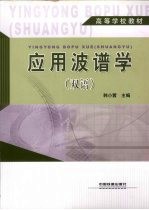
- 韩小茜主编 著
- 出版社: 北京:中国铁道出版社
- ISBN:9787113089252
- 出版时间:2008
- 标注页数:246页
- 文件大小:37MB
- 文件页数:256页
- 主题词:波谱分析-双语教学-高等学校-教材
PDF下载
下载说明
应用波谱学:双语PDF格式电子书版下载
下载的文件为RAR压缩包。需要使用解压软件进行解压得到PDF格式图书。建议使用BT下载工具Free Download Manager进行下载,简称FDM(免费,没有广告,支持多平台)。本站资源全部打包为BT种子。所以需要使用专业的BT下载软件进行下载。如 BitComet qBittorrent uTorrent等BT下载工具。迅雷目前由于本站不是热门资源。不推荐使用!后期资源热门了。安装了迅雷也可以迅雷进行下载!
(文件页数 要大于 标注页数,上中下等多册电子书除外)
注意:本站所有压缩包均有解压码: 点击下载压缩包解压工具
图书目录
Chapter 1 Ultraviolet and Visible Spectroscopy 1
1.1 Introduction 1
1.2 The Principles of Ultraviolet and Visible Spectroscopy 4
1.3 Electronic Transitions and Chromophore 11
1.4 Solvent Effects 13
1.5 Empirical Rules for Absorption Wavelengths of Conjugated Systems 14
1.6 Applications of UV Spectroscopy in Organic Structure Determination 28
Problems 30
New Words and Expressions 33
第1章 紫外可见光谱法 36
1.1 概述 36
1.2 紫外可见光谱原理 37
1.3 电子跃迁与生色团 39
1.4 溶剂效应 41
1.5 共轭体系吸收波长的经验规则 42
1.6 紫外可见光谱在有机化合物结构测定中的应用 42
Chapter 2 Infrared Spectroscopy 43
2.1 Introduction 43
2.2 Instrument and IR Samples 43
2.3 Theory of Infrared Spectroscopy 46
2.4 Infrared Spectra of Different Organic Compounds 55
2.5 Interpreting IR Spectra 69
Problems 78
New Words and Expressions 87
第2章 红外吸收光谱法 90
2.1 概述 90
2.2 红外光谱仪和红外样品处理 90
2.3 红外光谱的基本原理 91
2.4 各类有机化合物的红外光谱 95
2.5 红外吸收光谱法的应用 96
Chapter 3 Nuclear Magnetic Resonance Spectroscopy 98
3.1 Nuclear Spin States 98
3.2 Nuclear Magnetic Moments 99
3.3 The Chemical Shift and Shielding 101
3.4 The Nuclear Magnetic Resonance Spectrometer 104
3.5 Chemical Equivalence-A Brief Overview 104
3.6 Integrals and Integration 106
3.7 The Chemical Environment and the Chemical Shift 107
3.8 Local Diamagnetic Shielding 108
3.9 Magnetic Anisotropy 111
3.10 Spin-spin Splitting(n+1)Rule 113
3.11 The Coupling Constant 117
3.12 The Second-order Spectra 118
3.13 Aromatic Compounds 119
3.14 Interpretation of 1H NMR Spectra 122
3.15 Carbon-13 Nuclear Magnetic Resonance Spectroscopy 124
3.16 A Deeper Look:Calculation of 13C Chemical Shifts 130
Problems 137
New Words and Expressions 145
第3章 核磁共振波谱 147
3.1 核磁共振的基本原理 147
3.2 影响化学位移的因素 148
3.3 自旋偶合及自旋裂分 150
3.4 氢核磁共振谱图及其提供的信息 153
3.5 核磁共振波谱仪 155
3.6 碳-13的核磁共振波谱 155
Chapter 4 Mass Spectrometry 158
4.1 Introduction 158
4.2 Ionization Techniques 159
4.3 Determination of the Molecular Formula by Mass Spectrometry 168
4.4 The Mass Spectra of Organic Compounds 175
4.5 Interpretation to Mass Spectrometry 211
4.6 Interpretation of Four Spectra for the Identification of Organic Compounds 217
Problems 224
New Words and Expressions 230
第4章 质谱 233
4.1 概述 233
4.2 质谱分析的基本原理和质谱仪 233
4.3 质谱确定分子式 234
4.4 各类有机化合物的质谱 235
4.5 质谱解析 237
4.6 四谱的应用 237
Answers to Problems 238
Bibliography 246